
Introduction
The modern corporate ecosystem in Singapore often resembles a carefully curated brochure. Friday yoga sessions in the pantry. A corporate subscription to a meditation app. A newly minted wellbeing ambassador programme designed to signal to the market that the company cares. Yet, Singapore workplace wellbeing has become heavily skewed toward wellness branding rather than fixing the actual structural problems of the job itself. Flexible-work policies and mental-health training mean squat if people are still deeply stressed and consistently burned out every single day.
The metrics betray a grim reality hidden beneath these surface-level perks. Employers fund health promotion programmes hoping to patch up the psychological bleeding of a workforce that is inherently exhausted by its environment. They deploy chronic disease management workshops and set up a workplace counselling centre, completely bypassing the root causes of the distress. True wellbeing at work requires looking at the actual conditions people operate within, the psychological safety they feel, and the unspoken expectations tied to their performance.
What constitutes good corporate wellness locally?
To understand what actually moves the needle, one has to strip away the superficial office perks. A health promoting environment is entirely dependent on how human beings are treated when the pressure is high, not just when targets are met. Organizations must shift their strategic priority toward genuine relational depth.
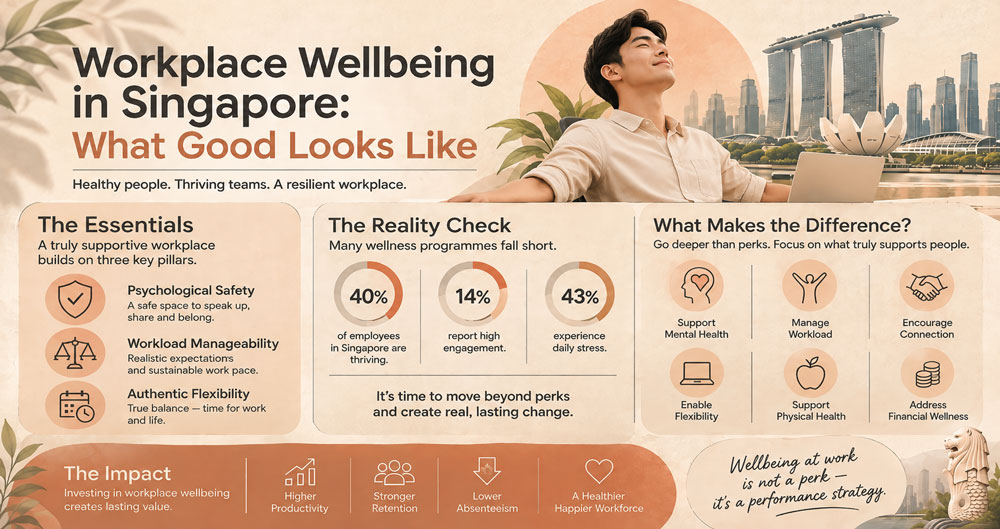
The foundation of a functional working environment rests on three specific pillars:
- Psychological safety and curiosity: A team member who hides a mistake because they fear punitive retaliation has not learned accountability. They have learned that smaller people get hurt by bigger people. Real authority is earned through trust and time, creating a space where individuals can express relationship difficulties or operational failures without shame.
- Workload manageability: Throwing a beanbag chair into a breakroom does not cancel out the effects of a 60-hour work week. Sane expectations require leaders to critically assess capacity, ensuring that the sheer volume of tasks does not chronically outpace the human bandwidth available to execute them.
- Authentic boundary respect: True flexibility means letting a remote worker log off at six without facing passive-aggressive emails at midnight. It involves actively navigating workplace demands so that time away from the desk is actually time away from the desk.
Psychological safety
A psychologically safe environment operates on co-regulation. When leaders manage their own anger and reactivity, they naturally foster resilience within their team. The organizational culture dictates whether a worker feels seen as a human being or merely optimized as a human doing. A reliance on enforced power only masks deeper structural decay.
Workload manageability
Corporations frequently ignore the simple mathematics of human energy. People are functioning with limited reserves. You cannot scale human impact indefinitely without rest. Constant optimization for output quietly erodes the conditions necessary for basic mental wellness.
Authentic flexibility
Many multinational companies operating in the region boast about their hybrid workplace options. However, physical absence from the office does not equal freedom if the digital leash remains tight. Flexible arrangements only succeed when the culture explicitly permits unplugging.
The disconnect between corporate initiatives and employee reality
The numbers make the disconnect painfully obvious. The recent Gallup Singapore Workplace Report indicates that only 40% of the workforce is considered thriving, while employee engagement sits stubbornly at a stagnant 14%. An alarming 43% report experiencing daily stress. When evaluating work overload prevention, employees rated their organizations a dismal 2.93 out of 5. These figures suggest that the vast majority of wellness initiatives are failing to bridge the gap between corporate intent and daily lived experience.
High daily stress rates
Stress is practically woven into the fabric of the Singaporean identity. Money and status carry heavy emotional weight here. The relentless script of constantly “upgrading” from an HDB to a condo, the pressure of securing the right school for a child, the creeping costs of inflation—all of this follows the employee into the office. The baseline anxiety is already elevated before the first email of the day is even opened.
Stagnant overall thriving scores
When companies prioritize basic compliance and obedience over genuine cultural shifts, overall employee satisfaction flatlines. They check the boxes. They offer the EAP. They tick the requirement for a mental health workshop. Yet, the human cost of a growth-at-all-costs mentality remains entirely unaddressed.
Persistent resilience illusion
Recent data revealed a fascinating, albeit dark, phenomenon. Workers’ stress-management skills improved by 10.4%, demonstrating incredible personal adaptability. Actual overall wellbeing, however, barely moved. That is not success. That is teaching people to cope with a bad setup. It signals a state of resilience without engagement, where employees are simply building thicker armor to survive a hostile working environment.
Implement structural support over superficial office perks
Organizations that genuinely want to improve their workforce need to look at the architecture of the work itself. Better systemic support dictates true wellbeing. If the environment is toxic, no amount of anger management seminars or nutrition education will fix the underlying trauma.
| Corporate Wellness Branding | Genuine Structural Support |
|---|---|
| Random Friday pizza parties | Auditing and capping maximum weekly working hours |
| App-based meditation subscriptions | Training managers in trauma-informed communication |
| Occasional mental health awareness days | Re-evaluating unrealistic KPIs and delivery timelines |
Mandate sane workloads
Workers are desperate for cultural transformations. The practice of letting tasks pass through a team without taking their sense of self with it is nearly impossible in a country with this much pressure. Companies must actively dismantle the expectation of constant availability and start funding realistic resource allocation.
Redesign team management
Management training often focuses purely on performance metrics and productivity. It rarely touches the “Inner O.S.” of the leader. A manager who operates from a place of unhealed stress will inadvertently bleed that stress onto their team. Relational repair requires teaching leaders how to nurture rather than command.
Eliminate systemic burnout
Burnout is not a personal failure; it is an occupational phenomenon. Resolving it often requires external expertise, from exploring treatment options for anxiety to finding certified burnout specialists who understand the nuances of the corporate grind. Organizations should facilitate these connections without attaching stigma.
What are current regulatory expectations for Singapore employers?
The landscape of corporate responsibility is shifting, albeit slowly. The official guidelines released by the WSHC provide clear frameworks for employers attempting to support employee mental health. Government bodies are increasingly pushing for wellness infrastructure that goes beyond mere suggestion.
Tripartite standards
The tripartite standards established by the Ministry of Manpower outline explicit employer responsibilities. These guidelines are pushing industries to move from passive awareness to active intervention, setting a baseline for what acceptable psychological support looks like. Understanding the Singaporean legal mandates for wellbeing is no longer optional for a modern consulting team or HR department; it is a critical operational requirement.
Flexible work policies
Regulatory bodies recognize that physical presence does not equate to value. Yet, worker-centric data highlighted by NTUC continually points out common pain points regarding working hours and the need for collective bargaining to secure better welfare. The push for formalized flexible arrangements is a direct response to this widespread burnout.
Fair employment practices
Discrimination based on health status remains a persistent issue, requiring stricter fair employment frameworks. A healthy workplace ecosystem cannot exist if individuals are terrified that seeking help will permanently derail their careers.
Why does mental health stigma persist at work?
Despite all the glossy corporate wellness messaging, a staggering 45% of employers remain hesitant to hire individuals with known mental health conditions. The messaging is pretty hollow when the hiring gatekeepers are still filtering candidates through a lens of prejudice.
This hesitation is deeply tied to a lack of education and entrenched societal biases. We still view mental struggles as a weakness or a liability, rather than a normal response to an abnormal amount of pressure. Findings from the AWARE Singapore workplace harassment study often reveal how quickly psychological safety dissolves when employees feel marginalized or judged for their emotional reality. Until leadership teams actively demonstrate that vulnerability does not equal incompetence, the stigma will remain firmly anchored in the corporate culture.
Measure cultural transformations instead of basic compliance
Behavioral compliance is a poor substitute for genuine character development in an organization. An employee who stops pushing back on bad ideas because they fear retribution has not become a better team player; they have simply learned to survive.
Metrics for success need to change. Tracking the number of people who attended a wellness workshop is useless. Measure retention. Measure the frequency of open disagreements that end in collaborative solutions. Measure the emotional fulfillment and psychological safety scores of marginalized workers. Real change is messy, uncomfortable, and deeply human. It cannot be neatly packaged into a quarterly report on employee satisfaction.
How do remote models affect local staff resilience?
The rapid shift to remote work introduced a complex layer of isolation. Technology promised connection but often delivered loneliness. When every interaction is scheduled, recorded, and optimized for efficiency, the natural human moments of co-regulation disappear. The casual conversation before a meeting, the shared exasperation over a broken printer—these small interactions build the relational tissue that sustains teams during hard times.
A hybrid model only supports resilience if it intentionally fosters offline connection. Without deliberate spaces for authentic human interaction, remote employees simply become anonymous nodes in a digital network, highly productive but fundamentally disconnected from their own humanity.
FAQ
Are employee assistance programs (EAPs) actually confidential in Singapore? Yes, reputable third-party EAP providers maintain strict clinical confidentiality. Employers receive aggregated data regarding usage rates and general trends, but never individual names or specific session details.
How can a manager spot early signs of burnout before a team member quits? Look for a sudden drop in curiosity. When a normally engaged employee stops asking questions, begins displaying cynicism toward new projects, or isolates themselves from casual team interactions, they are likely protecting a depleted energy reserve.
Does providing mental health days actually reduce long-term absenteeism? Providing the time off helps, but only if the workload is paused during their absence. If an employee takes a mental health day only to return to a punishing backlog of tasks, the intervention is functionally useless.
Conclusion
We live in a culture obsessed with scale, constantly driving toward more output, more efficiency, and higher status. That relentless pursuit has a profound human cost. Corporate wellbeing in Singapore will remain superficial until organizations are willing to look at the structural architecture of the work they demand. It requires moving past the illusion of resilience and the hollow promises of wellness branding. Real care involves sane workloads, earned authority, and the radical decision to treat employees as human beings, with all their messy, inherent complexities, rather than just units of production.

Michelle Mah is a psychotherapist, mindfulness practitioner, and wellbeing advocate who has transformed lives through her work with individuals and organizations.
Drawing from her personal journey overcoming mental health challenges including an eating disorder at the peak of her corporate career, she has been featured on TEDx, CNA, TODAY, and MoneyFM and aims to inspire others to achieve personal transformation and sustainable growth.
With expertise in delivering evidence-based wellbeing programs, Michelle integrates a variety of tools and modalities within psychotherapy, organisational development, mindfulness, and Neuro-Linguistic Programming (NLP) to help clients enhance resilience, self-awareness, and emotional wellbeing. Her credentials include an Advanced Psychotherapy Certification in Perinatal Mental Health and a 300-hour Yoga Alliance certification, having curated corporate wellbeing retreats across Asia.
She is also an adjunct lecturer at Nanyang Technological University and delivers programmes for Singapore Management University, bringing a unique blend of academic insight and practical strategies to empower individuals and youths.