
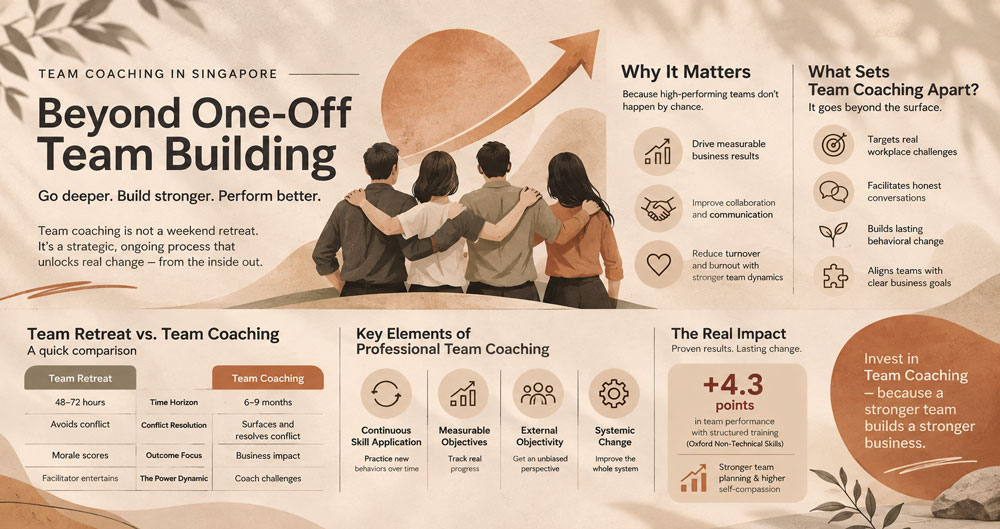
Every year, executive teams are used to offsite resorts, yet sometimes they may not know how to implement structural changes to their daily workflows or lead better. We are obsessed with the optics of teamwork. Team coaching in Singapore is fundamentally different. It is only useful when it fixes an actual, bleeding organizational problem. Paying someone to run feel-good workshops and call it a growth strategy is the exact bit of corporate theater I would avoid.
The numbers make the standard sales pitch look shaky incredibly fast. One-on-one business coaching is currently listed anywhere from $200 to $1000 a session across the island. A dedicated executive coach can comfortably command $500 to $1,000 per session. You need a highly specific goal and a robust way to measure progress before spending that kind of money on a collective intervention. We are routinely optimizing for output while quietly eroding the conditions that make people feel secure in their roles.
What Separates Professional Interventions From Corporate Retreats?
Real systemic team coaching strips away the polite corporate facade. It forces a group of highly paid professionals to look at the messy, tangled web of their own interpersonal dynamics. A retreat is an escape from reality. A professional coaching program is an uncomfortable dive straight into it.
To understand the gap between these two approaches, we need to look at how they function in a live corporate ecosystem:
- Time Horizon: Retreats last 48-72 hours. Coaching requires months of sustained effort and uncomfortable dialogue.
- Conflict Resolution: Team building avoids conflict to preserve the mood. Professional interventions intentionally surface underlying friction to repair structural damage.
- Outcome Focus: Retreats prioritize employee morale scores. Systemic coaching targets specific business deliverables and behavioral compliance.
- The Power Dynamic: A workshop facilitator entertains the room. A certified coach challenges the established hierarchy and questions unquestioned rules.
Continuous Skill Application
You cannot build a resilient leadership team over a weekend. True relational repair and rehab requires teaching people the difference between enforced power and authority earned through trust and time. This is why credible organizations favor structured team development engagements spanning six to nine months. Systemic alignment demands repetition. You have to practice the newly established communication frameworks in real meetings with real stakes.
Measurable Business Objectives
Without a baseline, any improvement is just a hallucination. When companies invest in an extensive coaching program, stakeholders expect tangible shifts in how decisions are made. Are projects launching faster? Is the turnover rate among mid-level managers dropping? The goal is to build a shared leadership structure where accountability is distributed rather than hoarded at the top.
External Facilitator Objectivity
You cannot read the label from inside the jar. Internal leaders carry heavy historical baggage. When a senior director tries to facilitate a session on psychological safety, the room instantly calculates the political cost of honesty. An external team coach brings unapologetic objectivity. They do not rely on the CEO for their annual bonus. They can point out the glaring dysfunctions that internal staff have spent years learning to silently navigate.
Systemic Behavioral Shifts
Individual performance does not automatically equal team performance. You can have a room full of brilliant, high-performing individuals who collectively function like a broken machine. A systemic approach maps out the connections between the people, the organizational culture, and the external stakeholders. It is about rewiring the entire system to support higher performance without burning the humans out in the process.
Track Measurable Performance Improvements Through Structured Frameworks
We need to stop pretending that interpersonal dynamics cannot be quantified. Structured interventions yield undeniable statistical improvements when executed correctly.
| Metric Category | Assessment Method | Typical Coaching Outcome |
|---|---|---|
| Goal Competence | Pre and post-intervention benchmarking | Increased strategic clarity |
| Non-Technical Skills | Observational scoring matrices | Higher behavioral compliance |
| Peer Collaboration | Multi-rater 360 feedback surveys | Reduction in departmental silos |
Oxford Non-Technical Skills
Let us look at the actual data. A prominent implementation study conducted across large healthcare institutions in Singapore showed that combining team training with standardized frameworks increased team performance scores via the Oxford Non-Technical Skills system by a massive 4.3 points. There is a deeply practical case for serious, measurable work. When a surgical unit or a corporate board learns to communicate without ego, the risk of catastrophic failure plummets.
Objective Goal Competence
Research from the Singapore Institute of Technology established a critical difference between internal educators and professional external coaches. External practitioners achieve significantly higher marks in driving team planning capabilities and self-compassion. This is a vital metric when addressing workplace burnout across high-pressure environments. Internal managers often push for relentless efficiency. External coaches teach resilience.
Enhanced Strategy Execution
Strategy without alignment is just an expensive slide deck. We see system-wide coaching adoption failing when leaders assume the strategy will execute itself. A cohesive team practice ensures that every member understands not just the technical steps of the project, but the relational dynamics required to push it over the finish line.
Navigate High-Context Workplaces and Corporate Hierarchy
Money and status are never just money and status in Singapore. They carry emotional weight. They carry the intergenerational journey from HDB flats to condominiums, career promotions, and the endless script of constantly upgrading. We operate in a society that reveres hierarchy.
Psychological Safety Cultivation
You cannot simply demand vulnerability. Telling a junior analyst to give radical, unfiltered feedback to a senior partner is incredibly dangerous if the environment lacks psychological safety. We often optimize our corporate structures for rigid compliance and wonder why our teams lack curiosity. Building trust in a high-context culture means teaching leaders how to actually listen without immediately preparing a defense.
Tone and Structural Deference
As a kid in a struggling household, you quickly learn to read the room. There are certain things you never ask for. Corporate professionals carry this exact same survival mechanism into the boardroom. Structural deference is baked into the local corporate DNA. Smaller people get hurt by bigger people. Many employees implicitly believe this is the natural order of the workplace. A skilled practitioner must carefully dismantle this belief to improve team dynamics without causing a mutiny.
Western Playbook Limitations
I would immediately bin any coach who imports a blunt Western-style playbook and expects it to work in Asia. The popular Silicon Valley approach expects people to aggressively speak their minds and challenge authority in public. Tone matters heavily here. If people do not feel inherently safe pushing back against their superiors, the entire workshop is just expensive theater. Localized team development requires nuance.
Implement Effective Development Methodologies for Group Alignment
We have to move beyond the superficial. A holistic team coaching program requires a rigorous framework.
First comes the diagnostic phase. We evaluate the collective competencies of the leadership team. We use multi-rater assessments to reveal the blind spots that the group has collectively agreed to ignore.
Next is establishing the working alliance. This is not a contract signed by HR. It is a psychological agreement between the coach and the team members. They must agree on how they will handle disagreements when the conversations inevitably become difficult. Often, leveraging a framework combining peer advisory and executive coaching provides the necessary structure to keep these discussions anchored in reality.
Finally, we deploy integrated coaching methodologies that force ongoing reflection. The group must learn to pause, assess their own communication patterns, and course-correct in real time. This is where true culture change happens. It happens in the mundane, weekly meetings where a leader chooses to ask a clarifying question instead of shutting down a junior staff member.
How Do Organizations Select Qualified External Practitioners?
The barrier to entry in the coaching industry is terrifyingly low. Singapore does not strictly regulate the word coach. Anyone with an Instagram account and a slight surplus of confidence can declare themselves a business consultant. This regulatory void creates massive variance in pricing and actual results.
Corporate buyers must demand validation. You should heavily favor practitioners carrying verified credentials from bodies like the International Coaching Federation or the European Mentoring and Coaching Council. An ICF credential signifies that the person has logged hundreds of hours of actual practice and undergone rigorous mentor coaching. They understand the fundamental differences between mentoring, training, and systemic team coaching.
You should also look for a coach who utilizes specialized multi-participant and 1-on-1 coaching rooms that foster deep focus. The environment dictates the depth of the work.
Why Do Internal Managers Struggle With Objective Facilitation?
A manager’s primary directive is to deliver business results. A coach’s primary directive is to develop the people delivering those results. These two agendas frequently collide.
Internal managers hold the keys to promotions, bonuses, and job security. When they attempt to facilitate a deeply vulnerable conversation about team dysfunction, the power dynamic suffocates the dialogue. Employees will always provide the answers they believe the manager wants to hear. Compliance is not character. A team that complies out of fear will eventually fracture under pressure.
Furthermore, particularly when coaching women leaders or marginalized groups within a corporate structure, an internal manager may lack the specialized training to navigate complex systemic biases. An external executive coach brings the necessary detachment to challenge the status quo safely.
FAQ
How long does a typical team coaching engagement last? Systemic interventions usually require a minimum of six to nine months. Behavioral shifts do not happen overnight. The team needs time to practice new skills, fail, and recalibrate during actual business operations.
Is team coaching the same as group coaching? No. Group coaching involves individuals who may not work together, focusing on their own personal development in a shared setting. Team coaching involves a collective unit working toward a shared business objective and shared leadership.
How do we measure the ROI of team coaching? You measure it through pre-agreed business metrics. This could include reduced project delivery times, lower attrition rates, improved 360-degree feedback scores, and the achievement of specific strategic goals set during the initial alignment phase.
Conclusion
We spend an enormous amount of our waking lives navigating the complex, often frustrating dynamics of our workplaces. Pretending that a quick-fix offsite retreat will solve deep systemic issues is a disservice to the humans doing the actual work. True team coaching in Singapore requires stepping into the discomfort of honest connection. It demands that we stop looking at our colleagues as mere instruments of productivity and start treating the team as a living, breathing ecosystem that requires intentional nurture.
The companies that thrive in the coming decades will not be the ones that squeeze the most output from their staff. They will be the ones that invest in the relational resilience of their teams. It is a much harder path to walk, but frankly, it is the only one that actually leads somewhere worth going.

Michelle Mah is a psychotherapist, mindfulness practitioner, and wellbeing advocate who has transformed lives through her work with individuals and organizations.
Drawing from her personal journey overcoming mental health challenges including an eating disorder at the peak of her corporate career, she has been featured on TEDx, CNA, TODAY, and MoneyFM and aims to inspire others to achieve personal transformation and sustainable growth.
With expertise in delivering evidence-based wellbeing programs, Michelle integrates a variety of tools and modalities within psychotherapy, organisational development, mindfulness, and Neuro-Linguistic Programming (NLP) to help clients enhance resilience, self-awareness, and emotional wellbeing. Her credentials include an Advanced Psychotherapy Certification in Perinatal Mental Health and a 300-hour Yoga Alliance certification, having curated corporate wellbeing retreats across Asia.
She is also an adjunct lecturer at Nanyang Technological University and delivers programmes for Singapore Management University, bringing a unique blend of academic insight and practical strategies to empower individuals and youths.