
Introduction
Most team building workshops in Singapore sometimes operate on a flawed premise where people assume proximity breeds trust. The reality is that an effective team building event demands structured, shared problem solving and psychological safety to genuinely improve workplace cohesion, rather than just putting fifty stressed employees in a room and hoping for the best. We are so starved for connection in this fast-paced corporate environment that we often confuse mere social activities with relational repair. Throwing money at a vendor to occupy your staff for an afternoon is easy. Cultivating a space where colleagues actually drop their defenses and learn to navigate conflict together is entirely different.
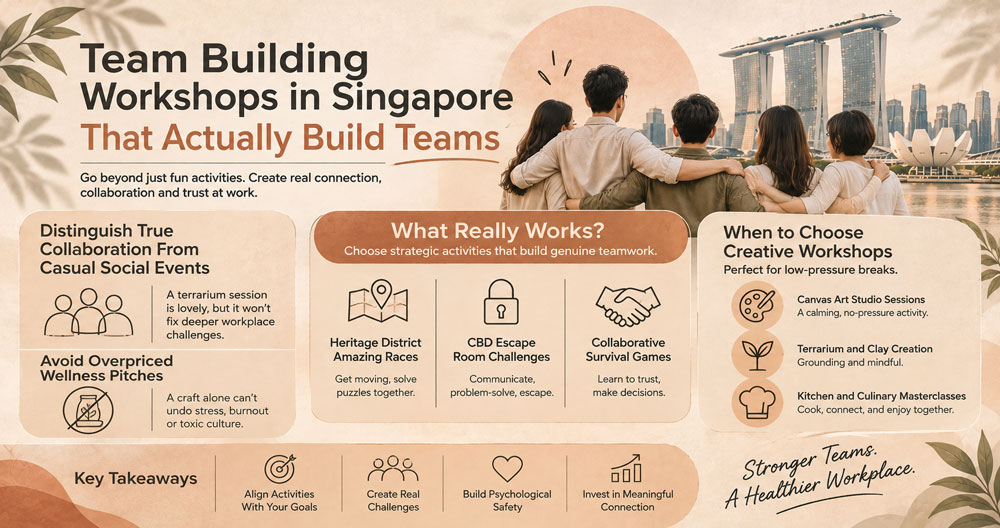
Distinguish True Collaboration From Casual Social Events
I see this constantly in my practice. A department head books a terrarium making afternoon, expecting it to suddenly bridge cross-cultural communication gaps across their diverse workforce. It will not. Most “team building workshop singapore” searches yield menus of pleasant distractions dressed up as deep organizational strategy. Making a clay pot is a lovely way to spend a Tuesday. Do not pretend it is going to fix systemic office burnout or heal a toxic department culture.
Overpriced Corporate Wellness Pitches
Let me be blunt about the industry. I would skip the pricey vendor pitch claiming that painting canvas tote bags is essential for employee retention and stress management. That is an enormous burden to place on a gel candle. The waste occurs when companies pay massive corporate wellness premiums for simple craft sessions, fully expecting these activities to magically undo months of relentless pressure. In Singapore, work carries immense emotional weight. The constant script of upgrading, the metrics, the sheer cost of living. You cannot buy cohesion with a 90 minute painting session.
Signs of Real Teamwork
Real teamwork requires friction. It requires a group of people facing a challenge, experiencing mild frustration, and learning how to co-regulate their nervous systems to reach a solution. You want to see how someone handles a missed clue or a failing strategy. That is where you improve team dynamics at the root level. If you strip away the challenge, you are just engaging in parallel play. A child who stops acting out because they fear punishment has not learned morality. Similarly, employees who smile through a mandatory bonding session have not learned to trust each other.
Appropriate Uses for Crafts
Sometimes people are just exhausted. If your team has been pulling grueling weeks in the central district, they probably lack the cognitive bandwidth for complex puzzles. In that case, book the art class. Call it a social event. Spend your budget accordingly and let your staff enjoy a few hours of quiet participation without the pressure of forced corporate epiphanies.
Which Strategy-Based Activities Actually Improve Workplace Cohesion
If your expected outcomes include actual cross-functional collaboration, you have to create an environment where people can talk. You need formats that reveal how information flows and where it bottlenecks.
Heritage District Amazing Races
I am a strong advocate for the outdoor treasure hunt format. Getting out of the office and walking miles around the city shifts the inherent power dynamics. The managing director is suddenly just another person sweating in the humidity trying to decipher a map. Experiences like a sustainability-themed puzzle hunt around Marina Bay compel participants to pool their observational skills and navigate ambiguous instructions under a strict time limit. This forces the kind of organic communication that boardroom meetings rarely permit.
CBD Escape Room Challenges
Lock people in a room. Give them sixty minutes to escape. You will learn more about your company communication styles in that hour than in a year of performance reviews. Who hoards information when the pressure spikes? Who gives up when the first attempt fails? Who quietly solves the puzzle while the loudest person takes all the credit? An escape room simulates the stress of a tight project deadline, revealing the true behavioral defaults of your employees.
Collaborative Survival Simulation Games
You can push this further into advanced territory. Programs that simulate survival scenarios require participants to allocate scarce resources and debate ethics. This mirrors the underlying mechanics of advanced trust-building activities, demanding real vulnerability and compromise rather than just behavioral compliance.
When to Book Creative Workshops for Casual Breaks
When the goal is purely downtime, low stakes environments work best. People need a breather.
- Canvas Art Studio Sessions: Quiet, self directed, and requires zero mandatory collaboration. Everyone walks away with a tangible item. Art jams offer a rare moment of spaciousness in an otherwise frantic week.
- Terrarium and Clay Creation: Highly structured and tactile. You can explore horticultural group workshops at natural spaces like HortPark for a grounding, nature-based reset. Working with soil is inherently calming.
- Kitchen and Culinary Masterclasses: Cooking together requires mild coordination but usually ends in a shared meal. Breaking bread naturally facilitates softer, more personal conversations that are nearly impossible to mandate.
Match Activity Formats With Specific Organizational Goals
Planning requires a cold look at your actual constraints. The duration, the headcount, the location. All of these variables dictate the psychological safety of the room.
Assess Total Group Size
You cannot run an intimate coaching circle with 200 pax. Large groups require highly scalable formats like a game show or trivia session. Small groups thrive in intensive, dialogue heavy environments. Understanding your group size prevents you from booking a delicate activity for a roaring crowd.
Determine Exact Budget Constraints
Let money pass through as a tool. Do not overspend on the illusion of wellness. If you simply need an offsite location to gather your thoughts, tracking average hourly rental rates for coworking spaces or private halls helps keep the budget grounded in reality. There are plenty of cheap team bonding options if you are willing to facilitate the discussions yourself.
Define Clear Expected Outcomes
Clarify what you actually want before you send the calendar invite.
| Organizational Goal | Recommended Format | Ideal Group Size | Energy Level |
|---|---|---|---|
| Stress Relief and Rest | Creative Arts and Crafts | 5 to 30 pax | Low |
| Cross-Functional Trust | Outdoor Scavenger Hunt | 10 to 50 pax | High |
| Communication Analysis | Indoor Escape Room | 4 to 8 pax per room | Medium |
| Large Scale Celebration | Banquet Trivia | 50 to 200 pax | Medium |
Navigate Venue Safety Standards and Hidden Singapore Costs
Singapore is efficient. Space is also notoriously expensive. Venues carry strict capacity limits and hidden equipment rental fees that can derail a well intentioned budget. If you are organizing a massive corporate retreat, you need to understand the physical limitations of the room. You can review specific corporate event spaces and capacity listings to understand exactly what a 24,500 square foot ballroom entails regarding logistics, acoustics, and seating arrangements.
Alternatively, some organizations look entirely off land to break the standard hotel mold, considering unique setups like a tall-ship alternative corporate venue for smaller executive teams. Always verify safety protocols. If you are booking high energy physical activities like combat archery, laser tag, or bubble soccer, the liability risks multiply. Ensure your vendor provides proper protective gear and clear safety briefings.
How Can Leaders Measure Success After the Event
We often measure success by sending a post event survey asking if people had fun. This is wildly insufficient. Fun is not the metric for relational repair. True engagement requires a thoughtful debrief.
You need to observe whether team performance actually improved when they returned to their desks. Do people feel safer speaking up during meetings? Are conflicts resolved with less resentment? Does the junior staff feel comfortable approaching the senior leadership after navigating a treasure hunt together? That is the real return on investment. If the office dynamics remain exactly as rigid and hierarchical as before, the workshop was merely a temporary distraction.
FAQ
What are some cheap team bonding activities in Singapore? You do not need to spend thousands of dollars to foster connection. Organizing a potluck lunch in a nearby park, running a self guided photo challenge around the civic district, or utilizing free online trivia games can be highly effective. The value is in the shared experience, not the price tag.
How long should a team building event last? A standard session usually runs between two to four hours. Anything longer requires careful pacing and substantial food breaks. If you push people into eight hours of mandatory engagement, you will encounter severe diminishing returns by the afternoon.
Virtual team building versus in person? Virtual formats became a necessity during remote work, but they often lack the visceral, somatic cues we rely on for trust. In person bonding experiences allow for micro expressions and spontaneous side conversations that a screen simply cannot replicate. Use virtual options for distributed global teams, but prioritize physical presence for local offices.
Conclusion
We are optimizing our corporate environments for maximum output while quietly eroding the conditions that make people feel seen. Throwing an axe at a wall or escaping a themed puzzle room will not cure a fundamentally broken management structure. However, when deployed intentionally, these team building experiences create a rare, level playing field. They strip away the titles and the email signatures, leaving behind actual humans who must figure out how to communicate, adapt, and rely on one another. That messy, imperfect interaction is the only foundation upon which real resilience is built.

Michelle Mah is a psychotherapist, mindfulness practitioner, and wellbeing advocate who has transformed lives through her work with individuals and organizations.
Drawing from her personal journey overcoming mental health challenges including an eating disorder at the peak of her corporate career, she has been featured on TEDx, CNA, TODAY, and MoneyFM and aims to inspire others to achieve personal transformation and sustainable growth.
With expertise in delivering evidence-based wellbeing programs, Michelle integrates a variety of tools and modalities within psychotherapy, organisational development, mindfulness, and Neuro-Linguistic Programming (NLP) to help clients enhance resilience, self-awareness, and emotional wellbeing. Her credentials include an Advanced Psychotherapy Certification in Perinatal Mental Health and a 300-hour Yoga Alliance certification, having curated corporate wellbeing retreats across Asia.
She is also an adjunct lecturer at Nanyang Technological University and delivers programmes for Singapore Management University, bringing a unique blend of academic insight and practical strategies to empower individuals and youths.