
Introduction
You sit in a hotel ballroom somewhere in the central business district. A facilitator enthusiastically clicks through a seventy-slide presentation about synergy. You smile politely. You nod. You are actually thinking about the four hundred unread emails accumulating in your inbox.
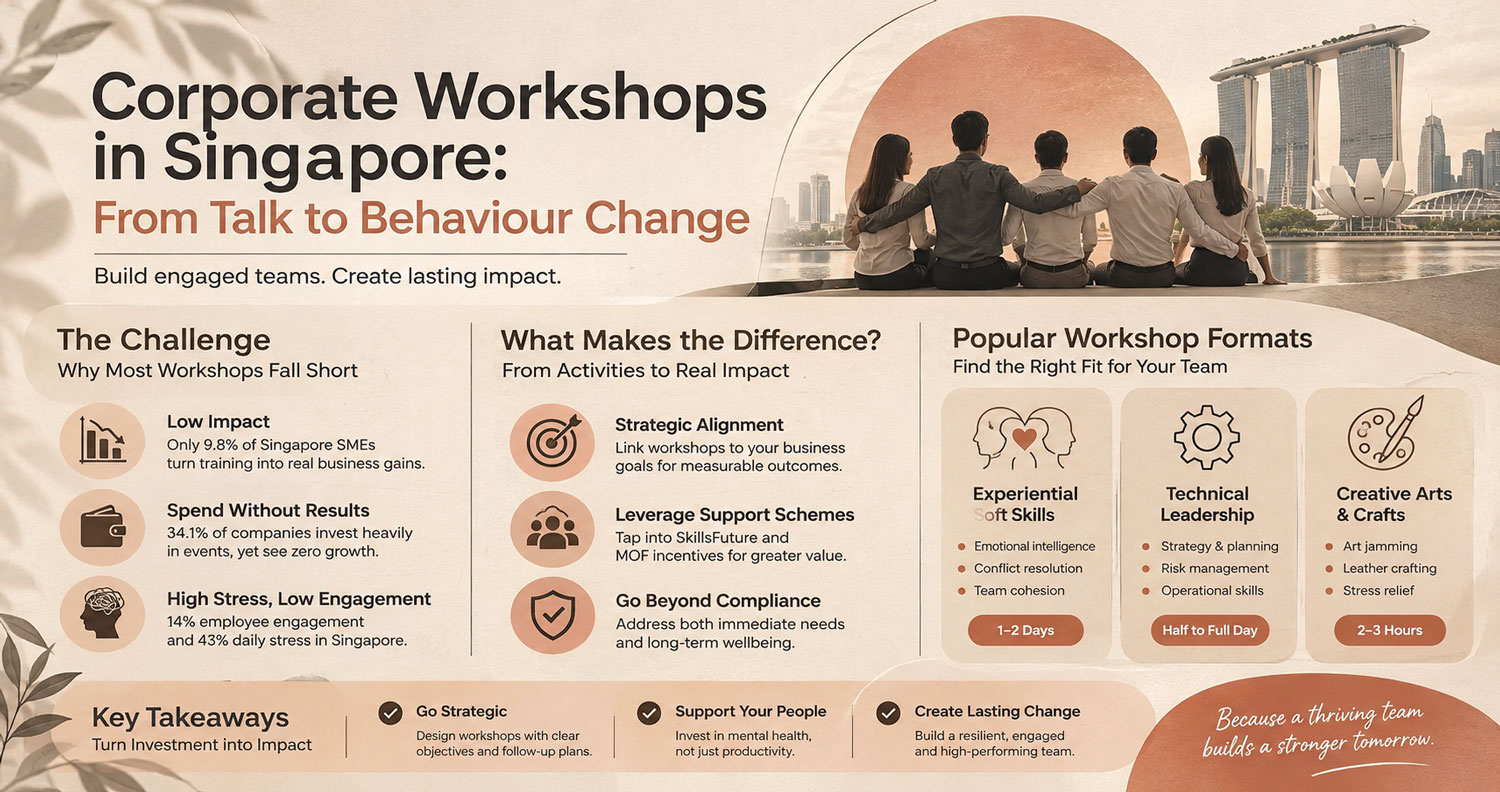
Corporate workshops in Singapore frequently masquerade as professional development when they are mostly just a polite way to burn through an annual team budget. We gather employees in a room, feed them decent catering, and expect profound psychological shifts by 5:00 PM. The data betrays this optimism. Recent metrics reveal that Singapore’s employee engagement sits at a stagnant 14% while daily stress hits 43%. We are optimizing for output and quietly eroding the conditions that make people feel seen. Read that again. Wait, do not read that again. That is a cliché. Just internalize the reality that putting stressed people in a room together does not magically create a healthy workplace.
Real team building demands deep relational work. It requires moving past passive compliance and stepping into genuine behavior change. It demands clarity.
Why Do Most Development Sessions Fail To Deliver Results?
The SME Strategy Gap
The numbers are genuinely brutal. Only 9.8% of Singapore SMEs reportedly turn training into tangible business gains. You cannot send an exhausted group of executives to a half-day seminar and expect them to restructure their entire collaborative ecosystem by Monday morning. A fun afternoon remains a fun afternoon. It is entirely disconnected from actual skills development unless there is a rigid plan for what changes afterwards.
The Traditionalist Expenditure Trap
Roughly 34.1% of companies fall into the “Traditionalists” category. They spend heavily on corporate events. They book the nicest venues. They see absolutely zero operational growth. They view professional development as a line-item expenditure rather than a strategic vehicle for change. This happens because leadership often outsources their management responsibilities to external trainers. They expect a guest speaker to somehow inject resilience into a workforce that is structurally overwhelmed.
Lack Of Operational Execution
Even the most evidence-based training is wasted when people return to the exact same job with the exact same workflow constraints. Nobody has time to practice active listening when they are drowning in administrative backlog. We must implement structural workflow adjustments before we can reasonably expect individuals to change their communication styles. The environment dictates the behavior.
What Separates Value Creators From Budget Burners?
Strategic Business Alignment
Value creators tightly align their people development programs with broader organizational architecture. They understand that top-quartile organizational engagement directly yields 23% higher profitability alongside dramatically lower turnover. They do not just book activities to check a box. They use workshops to solve specific, diagnosed internal bottlenecks.
SkillsFuture Framework Integration
The state heavily incentivizes continuous learning. Many firms tap into these digital gateways purely for the financial offset. The intelligent organizations map these subsidies directly to their long-term growth targets. They use the funding to foster authentic impact and psychological safety rather than just collecting certificates of attendance.
Ministry Of Manpower Incentives
Systemic safety requires relentless operational workshops. Singapore’s annualized major workplace injury rate dropped to a record-low 14.6 per 100,000 workers recently. That represents a massive victory for compliance training. Yet, occupational diseases rose to 620 cases during the same period, dominated heavily by noise-induced hearing loss. This highlights a massive gap. Technical training must evolve beyond basic safety compliance and address chronic, long-term environmental exposures.
Compare Popular Professional Education Formats
We have categorized the landscape into three distinct pillars.
| Format Category | Primary Focus | Typical Duration | Best Suited For |
|---|---|---|---|
| Experiential Soft Skills | Emotional intelligence, conflict resolution | 1 to 2 days | Leadership cohorts, newly formed teams |
| Technical Leadership | Hard skills, compliance, operational strategy | Half to Full day | Middle management, operations staff |
| Creative Arts & Crafts | Camaraderie, mental breaks, stress relief | 2 to 3 hours | High-pressure departments needing a pause |
Experiential Soft Skills Courses
These are the sessions designed to tackle the messy, human side of business. They focus on emotional intelligence, co-regulation, and team cohesion. The best ones rely heavily on participatory theater or customized workplace scenarios. They force participants to confront their own biases in real-time.
Technical Leadership Programs
This involves hard capabilities. Strategic planning. Financial modeling. Risk management. These workshops must integrate tightly with success coaching initiatives to ensure leaders actually know how to apply these frameworks to human beings, not just spreadsheets.
Creative Arts And Crafts
Let us be brutally honest about art jamming and leather crafting. These are wonderful mental health breaks. A miniature food clay making workshop or a two-hour candle making session offers a beautiful opportunity for mindfulness and self expression. Participants get to work with their hands. The tactile nature of jesmonite casting or terrarium building provides genuine relief from screen fatigue. They are highly customizable corporate workshops. They easily accommodate teams from 5 to unlimited pax.
Do not pretend they are leadership development.
A crafting activity fosters camaraderie. It gives colleagues something to talk about other than quarterly targets. That has value. Just understand that painting a canvas together will not resolve deep-seated organizational mistrust.
Build Sessions Around Actual Workplace Problems
Reject Passive Presentation Lectures
Corporate teams respond terribly to standard classroom lectures. You cannot teach collaboration through a slide deck. The human brain simply stops absorbing information when it is spoken at for hours in a dimly lit room.
Enforce Practice-Based Rules
Demand an active learning ratio. Up to 80% of the session must involve live role-plays, strategic feedback loops, and practice. You have to put people in uncomfortable, simulated situations. You have to let them mess up. Growth happens in the awkward pauses.
Establish Clear Accountability Structures
If nobody can name what should change next week, do not book the workshop. Assign specific individuals to monitor the new frameworks. If you spend two days learning a new feedback model, someone must ensure that model is actually used in the next departmental meeting.
Plan Your Next Team Education Strategy
Assess Internal Team Dynamics
You have to read the room. Before you mandate a high-energy team building activity, look closely at your staff. Are they exhausted? You must notice key behavioral workplace shifts like chronic cynicism or withdrawal. Forcing exhausted people to play trust-fall games is frankly cruel. Sometimes they just need workplace burnout coaching to restructure their workload before they can even engage with their peers.
Define Tangible Outcome Metrics
Decide what success looks like before you sign a contract.
- Behavioral shifts: Are managers holding better one-on-one meetings?
- Retention data: Have flight-risk employees stabilized?
- Workflow speed: Has inter-departmental friction decreased?
- Psychological safety: Do junior staff speak up more frequently in open forums?
Evaluate Vendor Methodologies
Look for facilitators who understand trauma-informed leadership. Look for vendors who value curiosity over compliance. Sometimes you need to get people entirely out of their usual environment. Urban adventure itineraries spanning Marina Bay and historic cultural enclaves can radically shift team perspectives, provided the facilitator knows how to guide the debriefing process.
How Do Local Firms Measure True Return On Investment?
They look past the immediate feedback forms. “Did you enjoy the food?” is a terrible metric for a corporate event.
True ROI is measured in friction reduction. How long does it take for a cross-functional team to resolve a dispute three months after the workshop? How many internal promotions happen within the cohort? The value creators track absenteeism rates. They track employee referrals. They measure the subtle, quiet indicators of empowerment and clarity. They understand that relational repair requires teaching the difference between enforced power and earned authority.
What Happens After The Facilitator Leaves?
This is where the actual work begins.
A child who stops bullying because they are afraid of the cane has not learned that hurting someone is wrong. They have only learned that getting caught has consequences. A similar psychology applies to corporate governance. Compliance is not character. If employees only collaborate because HR is watching the post-workshop metrics, you have failed.
You need to nurture the environment. You need to consistently reward the behaviors the workshop introduced. If a participant tries a new conflict resolution technique and is immediately shut down by a senior director, the entire investment evaporates in seconds. The ecosystem must support the new growth.
FAQ
What is the ideal duration for a team building workshop? It depends entirely on your objectives. A creative craft workshop for basic bonding usually takes 2 to 3 hours. Deep behavioral interventions and leadership restructuring require at least a full day, often spread across multiple sessions to allow for integration.
How much do corporate workshops in Singapore typically cost? The price varies wildly based on venue, duration, and the facilitator’s expertise. Art jamming or clay making might cost $30 to $80 per pax. High-level executive coaching and strategic alignment sessions can run thousands of dollars per day. You get exactly what you pay for in terms of behavioral outcomes.
Can these activities accommodate large groups? Yes. Many vendors offer customisable workshops designed for teams from 5 to unlimited pax. Virtual workshop options have also expanded dramatically, allowing remote and hybrid teams to participate in unified team bonding activities simultaneously.
Conclusion
We have to stop treating adult professionals like children who just need a fun field trip to behave better. Corporate workshops in Singapore carry massive potential to shift workplace culture, but only if we strip away the superficial theater.
Choose your interventions carefully. Honor the emotional weight your employees carry into the office every day. A thoughtful, compassionate, and fiercely practical approach to team education will always outperform a generic slide deck. Stop optimizing for perfect attendance. Start optimizing for human connection.

Michelle Mah is a psychotherapist, mindfulness practitioner, and wellbeing advocate who has transformed lives through her work with individuals and organizations.
Drawing from her personal journey overcoming mental health challenges including an eating disorder at the peak of her corporate career, she has been featured on TEDx, CNA, TODAY, and MoneyFM and aims to inspire others to achieve personal transformation and sustainable growth.
With expertise in delivering evidence-based wellbeing programs, Michelle integrates a variety of tools and modalities within psychotherapy, organisational development, mindfulness, and Neuro-Linguistic Programming (NLP) to help clients enhance resilience, self-awareness, and emotional wellbeing. Her credentials include an Advanced Psychotherapy Certification in Perinatal Mental Health and a 300-hour Yoga Alliance certification, having curated corporate wellbeing retreats across Asia.
She is also an adjunct lecturer at Nanyang Technological University and delivers programmes for Singapore Management University, bringing a unique blend of academic insight and practical strategies to empower individuals and youths.