
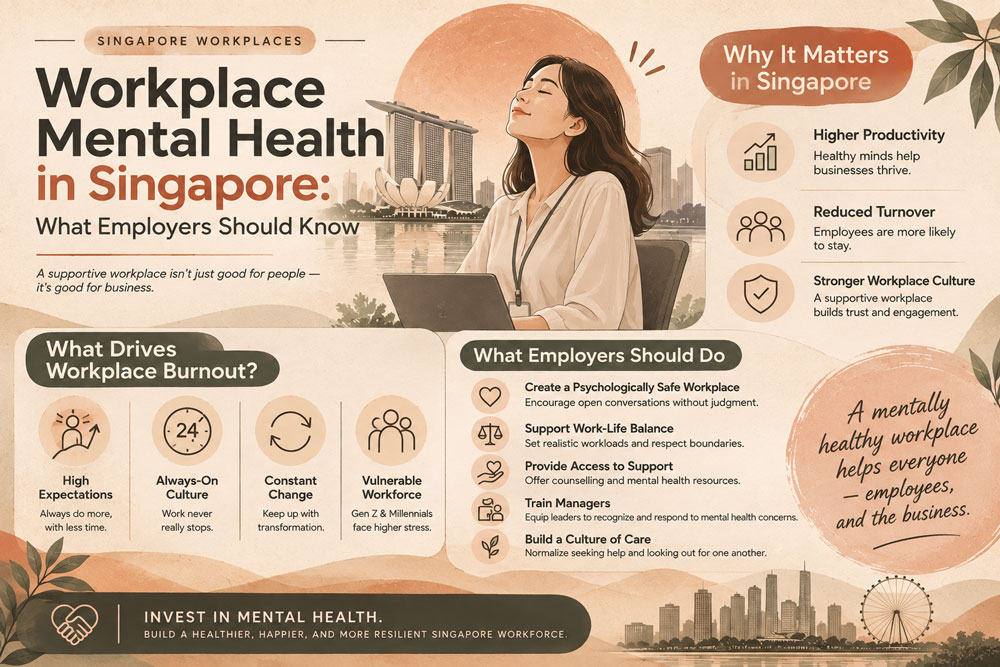
Everyone wants high performance. Very few want to build the psychological safety required to sustain it. Workplace mental health in Singapore is the deliberate practice of creating an environment where employees can function as human beings rather than mere units of production. It requires moving past superficial wellness days to address structural stress, unmanageable workloads, and poor leadership behaviors directly.
Corporate environments often operate on a deeply ingrained script of relentless upgrading. Career promotions. Better titles. Higher output. This drive demands incredible emotional capital from employees. When leaders ignore the human operating system, they do not get resilience. They get compliance masking deep exhaustion.
Why Does Workplace Mental Health Matter In Singapore?
The narrative that mental health conditions belong strictly in the realm of personal struggles is outdated. Workplaces are ecosystems. When the soil is toxic, nothing grows. The consequences of ignoring mental health challenges spill over into every measurable metric a business cares about.
High Economic Productivity Loss
Poor workplace mental health inflicts heavy losses on the local economy. Studies indicate a widening well-being disconnect costing billions in lost productivity due to absenteeism and presenteeism. Employers bleed an estimated 65.2 productivity days per worker each year when they fail to provide adequate psychological support, according to recent analysis on how poor workplace support costs Singapore employers. Money is never just money in this context. It represents a massive leak in corporate efficiency caused by untreated burnout and chronic anxiety.
Stagnant National Mental Strain
Workers are tired. Third-party data tracks a national mental health score hovering in the strained category. People are carrying the real costs of living, inflation, and social issues layered on top of older stories that more output is the only answer to success. Stagnation occurs because systemic issues remain unresolved. Employees face pressure to adopt new technologies rapidly without sufficient organizational support.
Imminent Regulatory Compliance Shifts
Mental wellness is transitioning from a soft human resources issue to a critical compliance framework. The upcoming Workplace Fairness legislation positions mental health as a protected characteristic. Companies will be forced to implement strict grievance handling procedures. This existing legal regime shift means leaders can no longer afford to be ignorant about psychological safety and health. Compliance is not character, but it will force minimum standards of decency.
What Drives The Corporate Burnout Epidemic Regionally?
The epidemic of exhaustion is not an accident. It is the natural consequence of how modern work is structured. To understand the collapse, you have to look at the structural loads placed on the workforce.
| Workforce Demographic | Reported Burnout Rate | Primary Stated Stressors |
|---|---|---|
| Gen Z | 68% | Lack of autonomy, always-on culture |
| Millennials | 65% | Change fatigue, caregiving burdens |
| Gen X & Boomers | 54% | Technological pace, job security |
Severe Organizational Change Fatigue
Organizations restructure constantly. They pivot. They optimize. They forget that human beings require stability to process information effectively. This change fatigue leaves employees disoriented. Leaders often push for faster scaling, ignoring that workplace burnout indicators are flashing red across their departments. Unquestioned scaling at all costs creates a culture that erodes human connection.
Unrelenting Always-On Expectations
There is a distinct structural contradiction in the modern business world. Data drawn from the Singapore workplace culture 2026 report highlights that 85 percent of employers expect their staff to be constantly reachable. Yet those same leaders acknowledge this behavior drives burnout. An employee who answers emails at midnight is not showing resilience. They are demonstrating a lack of boundaries driven by fear.
High Generational Workforce Vulnerability
Younger demographics bear the brunt of workplace strain. Gen Z and Millennial employees report significantly higher rates of exhaustion. They enter a workforce already optimized for maximum extraction. They are frequently told they lack grit when, in reality, they are operating in environments entirely devoid of psychological safety.
The Dangerous Disconnect Between Well-being Policy And Practice
Companies love checking boxes. They launch an Employee Assistance Programme (EAP), send out a corporate memo, and assume the problem is solved. Independent researchers point out a massive utilization gap. Resources exist on paper but fail to make a functional impact.
Low Assistance Program Engagement
Engagement remains abysmal. More than half of young professionals used zero mental health tools over a twelve month period despite having access to them. Why? Stigma. Fear of professional retaliation. Employees do not trust that their counseling services sessions will remain confidential. They see the EAP as an extension of corporate surveillance rather than genuine care.
Ineffective Managerial Resource Communication
Managers fail to properly communicate the availability of support. A manager who is drowning in their own workload cannot hold space for a struggling team member. They point to a link on the company intranet and consider their duty fulfilled. This is where how to prevent employee burnout in Singapore becomes a critical conversation about leadership capability, not just HR policy.
Persistent Daily Staff Stress
Corporate wellness days do not fix poor leadership. The Singapore workplace report 2026 indicates a sharp decline in workers who feel they are thriving, while daily stress remains stubbornly high. A yoga class on Friday cannot undo the damage of a verbally aggressive boss on Tuesday. The fundamental realities of the job must change.
Overcome Structural Challenges With Direct Employer Action
Healing requires more than platitudes. It requires structural changes to how work is designed and managed. Leaders must move beyond superficial interventions and embrace evidence-based practices that foster long-term growth and curiosity.
- Audit workloads comprehensively to ensure tasks align with realistic working hours.
- Mandate management training focused specifically on trauma-informed communication.
- Diversify counseling options by contracting professionals with multiple areas of specialisation.
- Normalize mental health days as standard sick leave without requiring clinical justification.
Redesign Sustainable Job Roles
Stop treating people like limitless batteries. Sustainable job design means aligning demands with human capacity. Researchers developing the Singapore workplace wellbeing scale have validated that boss support and autonomy tie directly to depression and anxiety outcomes. When employees have a say in how they execute their tasks, their psychological distress drops significantly.
Establish Clear Boundary Policies
If you want healthy employees, you have to protect their downtime. Establish firm policies restricting after-hours communication. Some tripartite guidelines even outline strict frameworks for this. Relational repair requires teaching a team the difference between enforced power and earned authority. A leader who respects time boundaries earns true authority.
Equip Leaders For Support
Managers must learn to recognize the subtle cues of emotional withdrawal. They need to spot when someone is struggling with relationship difficulties or hidden anger management issues before performance tanks. Frameworks detailing a tiered care model scaling support emphasize that early intervention at the community and corporate level prevents severe clinical crises later.
Prepare For The New Workplace Fairness Act
The landscape is shifting. Mental health is no longer just a nice to have initiative. It is moving into the realm of strict compliance.
Understand Protected Employee Characteristics
Under upcoming legislation, mental health conditions will be formally recognized and protected. Employers cannot discriminate against candidates or current employees based on a history of depression, anxiety, or PTSD. Organizations must educate their hiring managers thoroughly to eliminate systemic biases that view mental health struggles as a weakness.
Implement Strict Grievance Procedures
You need a formalized process. Employees must have a safe, confidential avenue to report discrimination or harassment related to their mental well-being. This requires impartial mediators and clear consequences for policy violations. Without safety, grievance procedures are just empty bureaucracy.
Audit Existing Wellness Frameworks
Look closely at your current vendors. Do your EAP providers offer diverse areas of specialisation? General counseling is often not enough. Employees may need support for specific trauma, addiction, or severe relationship difficulties. The Employee Assistance Programme pricing structures provided by government advisories show that quality clinical support is an investment. Do not cut corners on the psychological safety of your people.
How Can Companies Track Assistance Program Utilization Effectively?
Tracking utilization requires a delicate balance between gathering actionable data and maintaining absolute employee anonymity. Companies should demand aggregated, completely de-identified reporting from their external clinical providers. These reports should highlight broad trends rather than individual cases. For example, knowing that forty percent of access requests relate to anger management or relationship difficulties allows the HR department to tailor future organizational wellness seminars appropriately. Furthermore, pairing these external reports with internal, anonymous pulse surveys helps leaders measure the perceived safety of using the services. If the provider reports low engagement but internal surveys show high stress, you have a trust issue, not a demand issue. Employers must continually reinforce that accessing these services will never impact performance reviews or career progression.
FAQ
Are employers legally required to provide counseling services? While not every company is strictly mandated to provide an in-house psychologist, tripartite guidelines strongly urge employers to offer access to external EAP services. As workplace fairness legislation evolves, providing adequate support structures is becoming a baseline expectation for compliance and basic duty of care.
What areas of specialisation should an EAP include? A robust program must offer various areas of specialisation. Look for networks that include clinical experts in PTSD, grief, anger management, and relationship difficulties. Generalist advice often falls short when employees face complex trauma or severe burnout.
How do we handle an employee showing clear behavioral workplace shifts? Approach the situation with curiosity and compassion, not accusation. When you notice key behavioral workplace shifts, initiate a private, low-stakes conversation focused on their workload and stress levels. Offer adjustments to their immediate tasks and gently remind them of the available mental health resources.
Is executive burnout different from general employee burnout? Yes. Leaders carry complex isolation dynamics. The pressure to constantly project competence makes them hesitant to seek help. This is why specialized executive burnout therapy is crucial for high-pressure roles. They need a completely neutral space to deconstruct their corporate identity.
Conclusion
We are optimizing for output and quietly eroding the conditions that make people feel seen. Workplaces cannot continue to function as extraction machines. When you treat mental health purely as an individual failing, you miss the systemic rot entirely. True resilience is not about enduring abuse or unmanageable stress with a smile. It is about fostering an environment where clarity, connection, and psychological safety are the default operating system. Leaders must stop relying on superficial fixes and start doing the deep, often messy work of building cultures that actually support human beings. The cost of doing nothing is already too high.

Michelle Mah is a psychotherapist, mindfulness practitioner, and wellbeing advocate who has transformed lives through her work with individuals and organizations.
Drawing from her personal journey overcoming mental health challenges including an eating disorder at the peak of her corporate career, she has been featured on TEDx, CNA, TODAY, and MoneyFM and aims to inspire others to achieve personal transformation and sustainable growth.
With expertise in delivering evidence-based wellbeing programs, Michelle integrates a variety of tools and modalities within psychotherapy, organisational development, mindfulness, and Neuro-Linguistic Programming (NLP) to help clients enhance resilience, self-awareness, and emotional wellbeing. Her credentials include an Advanced Psychotherapy Certification in Perinatal Mental Health and a 300-hour Yoga Alliance certification, having curated corporate wellbeing retreats across Asia.
She is also an adjunct lecturer at Nanyang Technological University and delivers programmes for Singapore Management University, bringing a unique blend of academic insight and practical strategies to empower individuals and youths.