
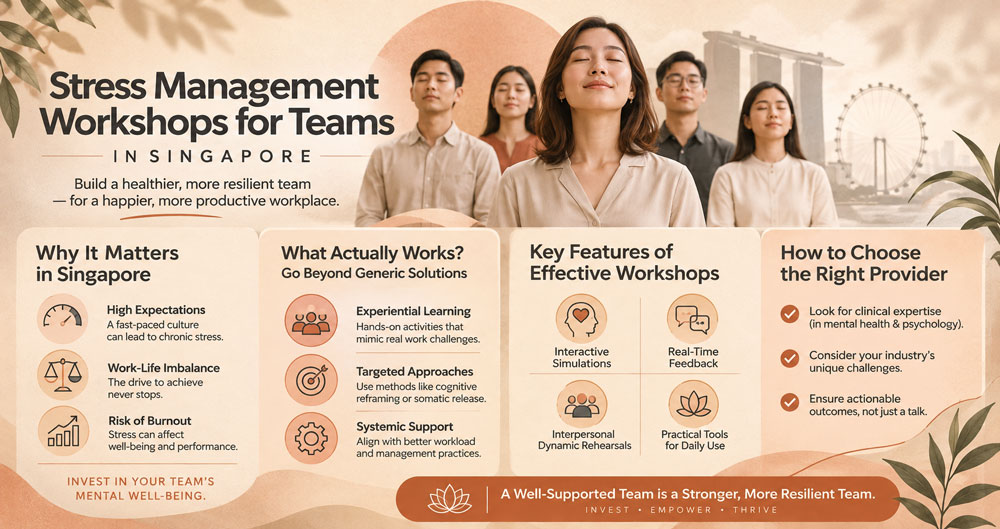
Organizations across Singapore routinely deploy a stress management workshop to equip their teams with cognitive frameworks and physiological practices designed to mitigate daily tension and prevent burnout.
Singapore carries a unique emotional weight. The script here is constantly about upgrading. HDB to condo. Manager to director. The relentless drive for productivity creates a heavy psychological toll, and companies often try to patch this by sending exhausted employees to generic training. A two-hour session making terrarium workshops might offer a brief afternoon distraction, but it does absolutely nothing to dismantle the systemic pressure of a toxic work environment. People are hungry for authentic connection and psychological safety. Not another slide deck telling them to breathe.
What Makes Corporate Wellness Programs Effective in Singapore?
Third-party evaluators and corporate participants consistently point to a massive disconnect between what management thinks is helpful and what employees actually need. Generic lectures on resilience fail because they do not change behavioral patterns. Effective programs bypass the traditional classroom slideshows and focus on the messy reality of the actual work environment.
Based on clinical feedback and institutional assessments, the consensus on what actually works falls into three very distinct categories:
- A hard pivot from theory to experiential learning: Moving away from academic lectures toward active, high-stakes roleplay that mimics the daily grind.
- Targeted methodology selection: Choosing specific interventions like cognitive reframing or somatic release based on the team’s exact physiological symptoms, rather than a one-size-fits-all approach.
- Addressing the systemic gap: Acknowledging that individual stress reduction is impossible without structural management alignment and workload audits.
When organizations integrate these elements alongside national physical and mental health interventions, the impact shifts from temporary relief to long-term behavioral change.
Interactive Corporate Simulations
The useful stuff is entirely practical. Rehearsing real pressure points like impossible Friday afternoon deadlines or hostile client calls provides a safe container for employees to observe their own nervous systems. Instead of listening to a trainer define the concept of anxiety, participants actively simulate the exact scenarios that trigger it. If a team is overwhelmed by client-related stress, the workshop must force them to navigate those exact conversations in real-time.
Real-Time Individual Feedback
A simulation is only as good as the observation that follows it. During these high-pressure exercises, a skilled facilitator watches the room. They point out when someone’s breathing becomes shallow, when anger flashes across a face, or when an employee defensively shuts down. Getting real-time feedback on physiological and emotional responses allows participants to map their own internal warning signs before a full blown crisis occurs.
Interpersonal Dynamic Rehearsals
Nasty work dynamics are rarely discussed openly in corporate settings. People smile, nod, and quietly harbor resentment. A strong workshop creates the space to rehearse difficult interpersonal conversations. It gives employees the permission to practice setting boundaries with aggressive stakeholders or pushing back on unreasonable requests without fearing retaliation. This type of relational repair requires teaching the difference between enforced power and earned authority.
Choose the Right Provider for Your Team
The market is flooded with motivational speakers claiming to teach resilience. Choosing the right provider means looking past the marketing brochures and demanding clinical depth.
| Evaluation Metric | Generic Corporate Trainer | Clinical Facilitator |
|---|---|---|
| Primary Focus | Behavioral compliance and productivity output | Relational depth and psychological safety |
| Intervention Style | Standardized slide decks and generalized advice | Trauma-informed, highly adaptable coaching |
| Success Metric | High participant survey scores at the end of the day | Measurable decrease in systemic office burnout |
Specific Industry Context
A tech startup bleeding cash operates under different pressure than a heavily regulated financial institution. The stressors are not identical. Providers must tailor their concepts to the specific industry. A facilitator working with a hospital wing must understand the nuance of compassion fatigue, whereas one consulting for a logistics firm might need to align with official tripartite guidelines regarding shift-work fatigue.
Facilitator Clinical Credentials
You need someone who understands trauma and behavioral science. Finding certified burnout specialists in Singapore matters because compliance is not character. A facilitator with a deep psychology background can spot the difference between an employee who is genuinely engaged and one who is simply masking their exhaustion to avoid punishment.
Actionable Deliverable Outcomes
What exactly is the company paying for when they cover the fee and the gst? The deliverable cannot just be a certificate of participation. It must include actionable management strategies that the team can deploy the very next morning. This might look like a revised protocol for handling urgent weekend emails or a structured peer-support system.
Apply Proven Frameworks to Neutralize Daily Tension
When the tension is palpable, teams need frameworks that work faster than their escalating heart rates. Different nervous systems require different types of regulation.
Mindfulness Based Reduction
An 8-week Mindfulness-Based Stress Reduction (MBSR) program is highly favored for building long-term cognitive resilience. This is not about sitting cross-legged and chanting. It is the rigorous practice of observing thoughts without immediately reacting to them. Incorporating targeted mindfulness interventions helps employees lower their self-reported anxiety and drastically improve their sleep quality, which is the baseline for any sustainable performance. For remote teams, online therapy for burnout and stress recovery support can mirror these group sessions effectively.
Cognitive Restructure Techniques
High-achievers in Singapore are notoriously prone to catastrophizing and perfectionism. Cognitive restructuring focuses on breaking these destructive thinking traps. It challenges the deeply held belief that a single failure will end a career. By dismantling these irrational fears, individuals can approach their tasks with clarity rather than panic. Sometimes, this requires directing employees toward comprehensive anxiety therapy in Singapore to unpack the intergenerational identity tied to their professional success.
Somatic Physical Release
Stress lives in the body. It tightens the jaw, hunches the shoulders, and wrecks the lower back. Workshops combining physical and muscular release provide immediate mental settling for individuals whose stress is deeply rooted in physical tension. Assisted stretching, deep belly breathing, and yoga literally force the nervous system out of a fight-or-flight state. An analytical breakdown of core elements in workplace wellness often highlights that physical movement yields the fastest measurable ROI in emotional regulation.
Why Do Generic Resilience Courses Fail Professionals?
A workshop cannot fix a workplace that deliberately keeps piling on the workload. This is the systemic gap. Companies frequently invest in professional stress management counseling for their staff while simultaneously demanding fifty-hour work weeks and weekend availability.
It is a profound organizational failure to externalize the blame onto the individual. When an employee is drowning in tasks, sending them to a seminar on time management is insulting. Management must learn to externalize systemic stress rather than treating burnout as a personal weakness. Independent reviews and clinical literature and educational material repeatedly highlight that employees perceive a massive disconnect between upper management promoting wellness and their true understanding of daily operational friction.
Build Office Routines to Prevent Employee Burnout
Spaciousness allows the deepening of who you are. Offices that run on perpetual urgency inevitably burn out their best talent. Building routines to protect employees requires intentional friction against the culture of speed.
Understanding how to prevent employee burnout in Singapore starts with auditing the calendar. Block out mandatory quiet hours where Slack messages and internal emails are prohibited. Give people the grace and permission to decline meetings that lack a clear agenda. Establish a participation structure that rewards deep, focused work rather than hyper-responsiveness. When leaders openly drop clients who cross boundaries, they signal to their team that mental health is actually valued over marginal revenue. Proper burnout reduction is an ongoing structural commitment.
How Can Leaders Audit Workloads Before Investments?
Before spending a single dollar on a stress management workshop, leadership must audit the environment. If the house is on fire, you do not teach the occupants how to tolerate the heat. You put out the fire.
Leaders can utilize an online psychosocial assessment tool to anonymously evaluate organizational stress factors. They need to look at the data. Who is consistently logging in at midnight? Which departments have the highest turnover? By referencing practical guidance outlining early warning signs, managers can identify structural bottlenecks that no amount of deep breathing will ever solve. Audit the communication expectations, the resource allocation, and the sheer volume of tasks assigned to each individual.
FAQ
What are the clear signs that a team needs an intervention? Look for the subtle shifts. Increased cynicism, chronic absenteeism, and a sudden drop in creativity are glaring indicators. When employees stop asking questions and merely comply with directives, the psychological safety of the group has already collapsed.
Does a standard stress management workshop include learning materials? Most credible providers will supply practical tools and learning materials, such as cognitive tracking sheets or guided audio practices. If the programme only offers a printed slide deck of inspirational quotes, look elsewhere.
Are these sessions strictly for corporate environments? No. While highly popular in business settings, working professionals across healthcare, education, and social services heavily utilize these management techniques. The core science of emotional regulation applies universally.
How does a team integrate these practices into a busy schedule? Effective time management is stress reduction. Teams must carve out 15-minute buffers between meetings to process information. Trying to manage stress by cramming a workshop into a lunch hour only adds to the pressure.
Conclusion
We are optimizing for output and quietly eroding the conditions that make people feel seen. Healing from chronic workplace stress is not a quick fix that can be neatly packaged into a Friday afternoon seminar. It requires a fundamental shift in how we view human beings—not as resources to be mined for productivity, but as complex individuals who require safety, connection, and rest. True stress and wellness management is the ongoing practice of building a culture where people do not have to armor up just to survive the workday.

Michelle Mah is a psychotherapist, mindfulness practitioner, and wellbeing advocate who has transformed lives through her work with individuals and organizations.
Drawing from her personal journey overcoming mental health challenges including an eating disorder at the peak of her corporate career, she has been featured on TEDx, CNA, TODAY, and MoneyFM and aims to inspire others to achieve personal transformation and sustainable growth.
With expertise in delivering evidence-based wellbeing programs, Michelle integrates a variety of tools and modalities within psychotherapy, organisational development, mindfulness, and Neuro-Linguistic Programming (NLP) to help clients enhance resilience, self-awareness, and emotional wellbeing. Her credentials include an Advanced Psychotherapy Certification in Perinatal Mental Health and a 300-hour Yoga Alliance certification, having curated corporate wellbeing retreats across Asia.
She is also an adjunct lecturer at Nanyang Technological University and delivers programmes for Singapore Management University, bringing a unique blend of academic insight and practical strategies to empower individuals and youths.