
Introduction
A corporate mental health talk in Singapore is frequently deployed as an administrative bandage over a systemic hemorrhage. The primary objective of these sessions should not be mere attendance tracking, but to fundamentally bridge the gap between corporate productivity demands and deep emotional intelligence, providing tangible resources for intervention. When organizations schedule a workshop for management and executives, they often treat psychological distress as a compliance metric to be managed. An expert speaking from a podium while employees check their emails under the desk. The unspoken reality betrays a different story. Professionals in this city carry immense intergenerational pressure to constantly upgrade—from HDB flats to condominiums, from junior executive to director—and that pressure exacts a heavy physiological toll.
Meaningful discourse requires moving past performative awareness. It demands psychological safety. True community mental health initiatives strip away the corporate veneer and address the raw, messy reality of human nervous systems operating under continuous stress. We are optimizing for output while quietly eroding the conditions that make individuals feel seen, heard, and valued.
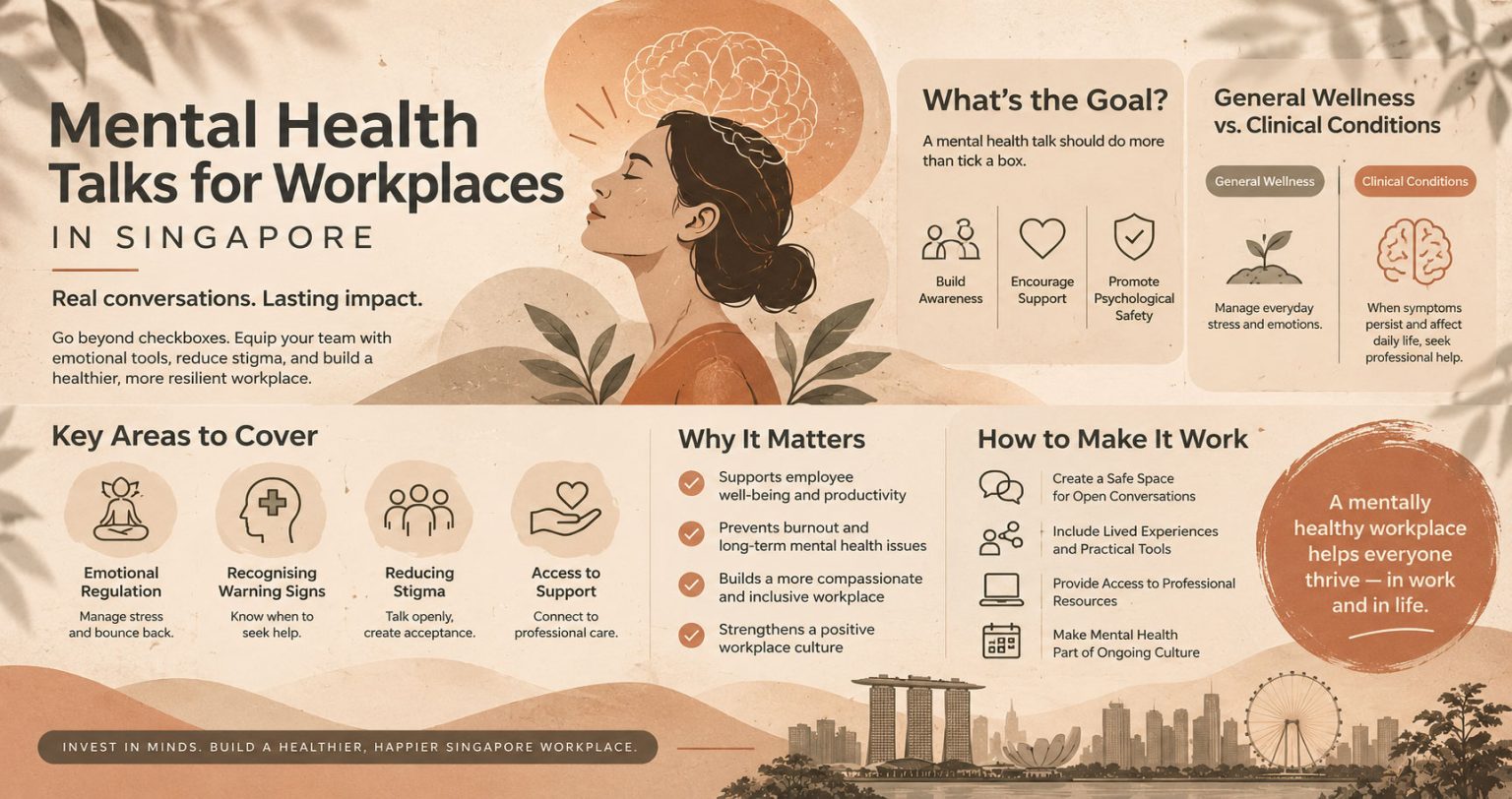
What distinguishes general wellness from clinical psychiatric conditions?
Society tends to conflate having a bad week with experiencing a clinical episode. General mental wellness refers to a baseline capacity to navigate daily stressors, regulate emotions, and maintain relationships without one’s internal operating system crashing. Clinical psychiatric conditions represent a structural and neurochemical departure from this baseline, requiring targeted, evidence-based care rather than superficial coping mechanisms.
Daily Emotional Regulation
Emotional regulation is the physiological practice of returning the nervous system to a state of safety after a threat has passed. When an individual spends 50 hours a week in a high-stress environment, their cortisol levels remain perpetually elevated. They lose the capacity for mindfulness. Nurture requires space. Without it, individuals default to survival mode, reacting to every email as if it were a physical threat.
Clinical Diagnostic Criteria
Psychiatric conditions are bound by specific, internationally recognized diagnostic parameters. When symptoms like severe insomnia, chronic anhedonia, or panic attacks persist for weeks, the situation crosses a distinct clinical threshold. This is the point where seeking anxiety therapy in Singapore transitions from a proactive measure to a medical necessity. The brain is an organ. Like any other organ, it requires professional treatment when its function is fundamentally compromised.
Impact On Functionality
The most reliable differentiator between acute stress and clinical illness is functionality. Can the individual maintain their physical hygiene? Are they entirely withdrawing from their community? Mental health issues often manifest in the body first—digestive problems, migraines, chronic fatigue. The disruption bleeds into every facet of life, rendering basic tasks monumental.
Professional Intervention Needs
When someone has experienced a mental disorder, public talks and seminars alone will not cure them. They require intervention from care professionals. Community mental health teams play an active role in providing structured support, bridging the gap between hospital settings and everyday life. Recovery demands compassionate, specialized expertise that goes far beyond generic wellness advice.
Navigate persistent social stigma despite current public awareness
A glaring paradox defines the current landscape. Singaporeans are increasingly literate in the terminology of trauma and therapy, yet genuine, on-the-ground acceptance remains stubbornly frozen. Data highlighting adult treatment gaps reveals that nearly eight in ten adults living with anxiety or depression avoid seeking formal help due to intense fears regarding confidentiality and judgment.
Address Social Distance
Public campaigns successfully raise public awareness on issues relating to the individual, but they rarely dismantle “social distance.” People can theoretically identify depression, but they often hesitate to hire, date, or closely collaborate with someone actively coping with mental issues. Society tolerates mental illness in the abstract while subtly punishing it in proximity.
Overcome Institutional Scepticism
Top-down structural adjustments frequently meet justified skepticism. The announcement to redevelop and rename the Institute of Mental Health (IMH) to the National Centre for Mental Health Singapore is a bureaucratic pivot. It does not automatically reprogram deeply entrenched cultural mindsets. Real shifts require understanding the protective coping habits tracked in the nationwide mental health survey, ensuring policies reflect grassroots realities rather than just institutional white papers.
Integrate Lived Experiences
Policy planning relies heavily on clinical experts, routinely bypassing the very community it seeks to serve. “Nothing about them, without them.” Policymakers must integrate voices of those experiencing mental health issues directly into their frameworks. Lived experience brings a profound clarity that no textbook can replicate.
Normalize Professional Help
The statistics are sobering. The National Population Health Survey 2025 psychological distress metrics underscore that severe distress remains most prevalent among young adults aged 18 to 29. Normalizing professional help means dismantling the belief that suffering in silence is a virtue.
Protect employees against career repercussions and disclosure fears
Employees remain terrified of the consequences of disclosure. In a highly competitive corporate ecosystem, revealing a diagnosis often feels like career suicide.
Workplace Fairness Act
While frameworks like the Singaporean legal mandates for wellbeing offer theoretical protection, culture consistently overrides policy. Workers fear being labeled a liability, passed over for promotions, or socially isolated by management. Trust must be earned through consistent, safe leadership, not just legislated.
Anonymous Support Channels
Until psychological safety is demonstrably real, organizations must provide access to uncompromised, confidential care. Offering online therapy for burnout and stress recovery support ensures that executives and staff can seek help without fear of their data ending up in an HR file. Anonymity is a prerequisite for honesty when career progression is on the line.
Peer Support Networks
Interestingly, independent Duke-NUS peer support findings point out that 62 percent of adults remain open to peer support even when they actively avoid formal clinical care due to stigma. Building internal networks of trained, empathetic colleagues offers a crucial bridge to professional services.
Build psychological resilience through daily actionable emotional health strategies
Resilience is not about enduring infinite amounts of stress without complaining. It is the active, intentional practice of regulating the nervous system and designing a life that supports holistic health.
- Audit social and environmental inputs: Constantly consuming content centered on extreme wealth, hustle culture, or catastrophic news dysregulates the nervous system. Curate inputs that foster curiosity and calm.
- Practice intentional spaciousness: Build physical and temporal buffers into the day. Leave a 15-minute gap between meetings. Cancel social obligations that drain energy. Spaciousness allows the nervous system to recalibrate.
- Engage in somatic grounding: Emotional health is inextricably linked to physical states. Simple practices like walking outside, noticing sensory details, or engaging in rhythmic movement help discharge accumulated stress cycles from the body.
- Deconstruct the “upgrading” script: Actively question the intergenerational narrative that more material affluence equals more happiness. Detaching self-worth from title and income brackets provides immense emotional freedom.
Directory of professional psychiatric and therapy resources in Singapore
Knowing where to find help is half the battle. When public talks are insufficient, specialized resources provide the necessary scaffolding for recovery. Individuals seeking specialized support must know where can I find certified burnout specialists in Singapore to ensure they receive targeted, trauma-informed care.
| Organization / Service | Focus Area | Access & Utility |
|---|---|---|
| National Council of Social Service (NCSS) | Community subsidies | The National Council of Social Service Subsidized Counselling framework provides accessible pilot subsidies for initial sessions for qualifying individuals. |
| Samaritans of Singapore (SOS) | Crisis intervention | Essential for acute distress. The 2026 Suicide Statistics press release highlights critical spikes among specific age demographics, emphasizing the need for 24/7 hotline access. |
| Institute of Mental Health (IMH) | Clinical psychiatric care | Offers comprehensive medical intervention, emergency psychiatric services, and specialized outpatient clinics for severe clinical conditions. |
| Singapore Counselling Centre | General psychological support | Provides structured therapy for individuals, couples, and youths navigating anxiety, depression, and relationship challenges. |
For individuals navigating the system independently, utilizing a CMH wayfinding tool can drastically reduce the cognitive load of finding appropriate care professionals in their specific district.
How do managers measure wellness program success effectively?
Organizations frequently measure the wrong metrics. Counting the number of attendees at a lunch-and-learn seminar provides zero insight into the actual psychological safety of a team. Managers must shift their focus from output metrics to relational metrics.
Are employees taking their annual leave without being harassed on WhatsApp? Is there a noticeable reduction in unexplained absenteeism? The National Mental Health and Well-being Strategy full PDF report sets out national indicators targeting early help-seeking behaviors. Corporate leadership should mirror this by measuring how quickly and comfortably employees request support. Empowerment looks like a team that feels secure enough to admit when they are drowning, knowing their manager will throw them a life raft, not a performance improvement plan.
FAQ
Can a school or organisation request custom mental health talks? Yes. Many specialized clinics and community mental health teams conduct seminars tailored to specific demographics, whether it is an assembly for youths or a targeted workshop for management.
What is the role of a peer support specialist? Peer support specialists are individuals who have experienced a mental disorder in their lifetime and have undergone rigorous training. They use their lived experience to provide empathetic, non-judgmental emotional support, proving highly effective in bridging the gap between isolation and clinical care.
How do polyclinics support mental wellness? Polyclinics are increasingly integrating mental health services into primary care. They offer initial screenings, basic counseling, and referrals to specialized institutions for individuals experiencing mental health issues, ensuring support is accessible at the neighborhood level.
Conclusion
The obsession with scale and efficiency has created a corporate environment that treats human beings as highly optimized machines. They are not. Relational repair and emotional intelligence require an investment of time, patience, and profound honesty. Organizing a mental health talk in Singapore is a starting point, but it must be backed by a genuine commitment to dismantle stigma, protect vulnerable employees, and foster environments where individuals can thrive holistically. Connection remains the ultimate antidote to the isolation of modern professional life.

Michelle Mah is a psychotherapist, mindfulness practitioner, and wellbeing advocate who has transformed lives through her work with individuals and organizations.
Drawing from her personal journey overcoming mental health challenges including an eating disorder at the peak of her corporate career, she has been featured on TEDx, CNA, TODAY, and MoneyFM and aims to inspire others to achieve personal transformation and sustainable growth.
With expertise in delivering evidence-based wellbeing programs, Michelle integrates a variety of tools and modalities within psychotherapy, organisational development, mindfulness, and Neuro-Linguistic Programming (NLP) to help clients enhance resilience, self-awareness, and emotional wellbeing. Her credentials include an Advanced Psychotherapy Certification in Perinatal Mental Health and a 300-hour Yoga Alliance certification, having curated corporate wellbeing retreats across Asia.
She is also an adjunct lecturer at Nanyang Technological University and delivers programmes for Singapore Management University, bringing a unique blend of academic insight and practical strategies to empower individuals and youths.