
Walk into almost any corporate boardroom in the central business district and someone will inevitably mention the urgent need for upskilling. The undeniable reality remains that much of the emotional intelligence training in Singapore functions as highly overpriced vocabulary for teaching executives how not to be lousy managers. A framed piece of paper declaring someone a certified practitioner does not magically fix a director who lacks the basic capacity to listen or regulate their temper. Genuine emotional intelligence training focuses entirely on measurable behavioral changes rather than abstract corporate buzzwords. It equips leaders with the specific habits needed to stay calm under pressure, navigate complex interpersonal conflicts, and foster psychological safety within an intensely demanding work culture.
Why Do Singapore Leaders Need Emotional Intelligence?
Corporate Singapore carries immense historical and social weight. The local script constantly demands upgrading from public housing to private condos, chasing career promotions, and expanding one’s network. Money and status easily become the language professionals use to talk about who they are allowed to be. This pressure cooker environment routinely prioritizes output over human connection.
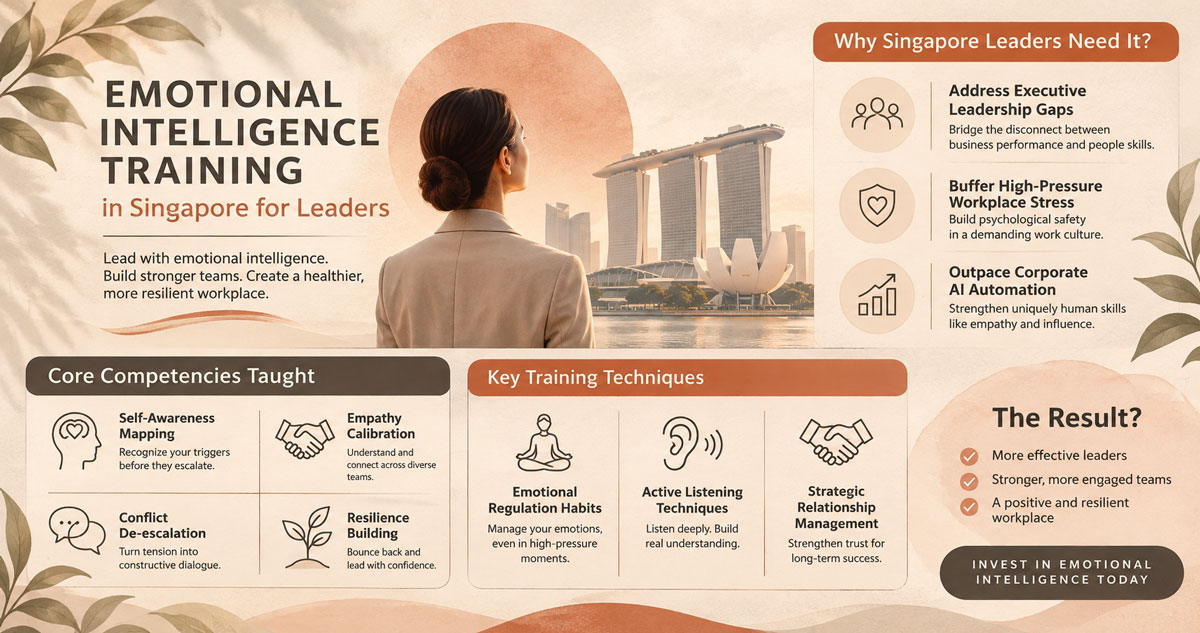
Address Executive Leadership Gaps
Organizations operate under a severe disconnect at the top of the hierarchy. A striking survey involving 150 business leaders and 300 professionals revealed an uncomfortable truth about corporate dynamics. Even though over ninety percent of respondents agree on the importance of interpersonal abilities, employees in Singapore cite emotional intelligence as a key leadership gap at the executive level. Executives frequently manage metrics efficiently but completely misread the emotional landscape of their teams. They demand compliance instead of building character. This structural deficit alienates staff and severely diminishes overall team productivity.
Buffer High-Pressure Workplace Stress
High-pressure environments slowly erode the psychological safety required for deep collaboration. Leaders who lack foundational awareness often project their own anxieties onto their subordinates during difficult conversations. The practice of active psychological framing becomes a critical buffer against this pervasive workplace stress. Professionals must learn to separate the immediate problem from the individual person. Without proper leadership training, unresolved tension easily metastasizes into chronic exhaustion. Often, professionals eventually find themselves searching for certified burnout specialists in Singapore simply because their organizational culture failed to provide basic emotional support.
Outpace Corporate AI Automation
Technical proficiency no longer guarantees career longevity. Automation rapidly commoditizes basic analytical tasks and standard operational workflows. The ability to influence stakeholders, calibrate empathy, and manage localized change initiatives remains distinctly human. Forward-looking academic reviews focused on rethinking learning in the age of generative AI note that these relational competencies represent the primary structural differentiator for future leaders. Exploring 5 common myths debunked for Singapore professionals reveals that artificial intelligence cannot replicate the nuanced trust required to navigate sensitive organizational transitions.
Core Competencies Taught in Standard Singapore Curriculums
Most structured curriculums map their content to established psychological frameworks or national workforce standards. They aim to translate internal emotional states into observable, constructive behaviors that benefit the entire organization.
- Self-Awareness Mapping: Identifying specific physiological and psychological triggers before they result in disruptive impulses.
- Empathy Calibration: Adjusting communication styles to match the emotional capacity and cultural background of diverse team members.
- Conflict De-escalation: Utilizing specific phrasing and vocal tones to reduce defensiveness during high-stakes disagreements.
- Resilience Building: Recovering quickly from professional setbacks without internalizing the event as a permanent flaw.
Emotional Regulation Habits
No amount of corporate strategy matters if a leader cannot control their own nervous system during a crisis. Standard modules focus heavily on identifying the physical signs of frustration and implementing immediate regulatory responses. This involves recognizing personal triggers and pausing before reacting. Individuals struggling with severe impulsive reactions sometimes require deeper emotion regulation work to understand how their bodies physically process corporate anxiety.
Active Listening Techniques
Listening in the corporate world usually looks like waiting for a turn to speak. Real active listening demands silencing the internal monologue and focusing entirely on the other person’s underlying concerns. Training courses emphasize the importance of reflecting back what was heard to ensure total alignment. This simple technique radically reduces misunderstandings and builds a foundation of earned authority rather than enforced power.
Strategic Relationship Management
Relationships dictate the speed of business. The foundational competencies outlined by major human resource bodies specifically reference empathetic stakeholder communication as a non-negotiable standard. Leaders learn to navigate office politics without resorting to manipulation. They practice building consensus by acknowledging the diverse emotional needs of different departments, ensuring that collaborative efforts do not collapse under the weight of unaddressed grievances.
Choose Actionable Programs Over Abstract Corporate Workshops
Organizations waste millions of dollars annually on feel-good seminars that produce zero lasting behavioral change. Abstract talk about cultivating holistic competencies sounds wonderful in a brochure but falls apart the moment a project deadline shifts.
| Training Approach | Primary Focus | Long-Term Result |
|---|---|---|
| Abstract Workshops | Personality categorization, theoretical models, generalized team bonding activities. | Temporary morale boost. Old habits return within weeks under pressure. |
| Actionable Programs | Role-playing specific scenarios, immediate feedback, stress-testing communication skills. | Measurable reduction in workplace friction. Sustained changes in conflict resolution. |
Drill Specific Stress Reactions
Behavioral change requires repetition. An effective course forces participants into uncomfortable simulated scenarios. A trainer might intentionally agitate a participant to test their ability to maintain composure. This controlled friction exposes the gap between knowing what to do and actually doing it. Practicing these specific reactions builds the neurological pathways necessary to access those skills during real-world crises.
Separate Problem From Person
Relational repair relies heavily on this single concept. When a project fails, the default human instinct seeks a scapegoat. High EQ leaders learn to attack the structural failure while explicitly protecting the dignity of the staff involved. This distinction promotes real accountability. Shame makes people hide their errors. Real remorse, facilitated by a supportive manager, promotes actual organizational repair and continuous learning.
Shift Leadership Promotion Metrics
A systemic issue requires a systemic solution. There is a growing public demand to explicitly train supervisors in mental well-being and emotional intelligence before they ever assume managerial control. Promoting an individual based strictly on technical performance or seniority, while ignoring their history of abrasive interpersonal interactions, actively destroys team cohesion. Companies must begin evaluating promotions based on how individuals actually treat their colleagues.
Review Course Learning Objectives and Practical Assessments
You cannot manage what you do not measure. Evaluating the effectiveness of these programs requires moving beyond simple satisfaction surveys handed out at the end of a session.
Practical Skill Application
Participants usually leave an effective training programme with a highly specific action plan. They identify exact workplace situations where they intend to apply their new communication skills. This might involve changing how they run weekly team meetings or altering their approach to performance reviews.
Peer Evaluation Frameworks
The true test of a leader’s emotional intelligence is not how they view themselves, but how their team experiences them. 360-degree feedback mechanisms remain crucial. Colleagues, subordinates, and superiors provide anonymous insights into the leader’s actual behavior. It forces leaders to confront the sometimes massive disparity between their intentions and their impact.
Behavioral Change Measurement
Emotional intelligence is ultimately about what other people saw. If a manager claims to possess high EQ but their team constantly walks on eggshells, the manager lacks true awareness. Sometimes, navigating these deeply ingrained blind spots requires dedicated leadership coaching to unravel defensive postures that standard classroom settings cannot fully address.
Verify Course Logistics, Eligibility, and Grant Options
Navigating the administrative side of professional development in Singapore requires understanding the local funding landscape.
SkillsFuture Subsidy Utilization
The government heavily subsidizes continuous education to maintain a competitive global workforce. Many corporate modules, including the standard applying emotional intelligence at the workplace programs, qualify for significant funding. Companies can utilize their SkillsFuture Enterprise Credit, while individuals can tap into their personal SkillsFuture Credit to offset course fees. Employers also frequently claim absentee payroll funding to minimize the financial impact of sending staff to full-day classes.
Target Audience Requirements
While universally beneficial, these courses often target specific organizational tiers. Some modules focus exclusively on newly promoted managers who suddenly find themselves navigating complex team dynamics. Others cater to senior executives who need to refine their strategic influence. Identifying the correct program ensures the learning outcomes match the participant’s daily professional reality.
Standard Program Durations
The duration of these interventions varies widely based on depth. A basic introductory workshop might span a single afternoon, providing a superficial overview of personality types like the Enneagram. Comprehensive certifications often demand two to three full days of intensive, synchronous practice, followed by months of supervised application in the workplace.
Do Certifications Actually Fix Poor Leadership Behaviors?
Certificates represent attendance, not necessarily competence. An individual can memorize Daniel Goleman’s entire framework, ace a written assessment, and still berate their assistant the following morning. Behavioral compliance in a classroom setting is a poor substitute for genuine character development. Deep-rooted interpersonal issues, particularly severe emotional regulation difficulties, rarely resolve after forty-eight hours of group exercises. True growth requires a willingness to engage in the messy, uncomfortable work of examining one’s own internal operating system over a sustained period.
What Alternative Methods Cultivate Empathy Without Workshops?
Classrooms are not the only venues for professional growth. Often, the most profound shifts occur through unstructured, intentional connection. Mentorship programs that pair senior executives with junior staff from entirely different socioeconomic backgrounds naturally force empathy calibration. Encouraging a culture of slow living and spaciousness within the workday allows colleagues to engage in authentic conversations without an agenda. Building stronger teams organically requires dismantling the rigid, hyper-optimized schedules that currently dominate corporate life.
FAQ
How do organizations measure the return on investment for these courses? Companies track metrics such as reduced staff turnover rates, fewer internal HR complaints, and increased cross-departmental collaboration. Successful implementation visibly lowers the ambient stress level of the organization.
Are online classes as effective as in-person training for interpersonal skills? Online formats efficiently deliver the theoretical content and cognitive frameworks. However, mastering the subtle nuances of body language, vocal tone, and energetic presence usually demands the immediate feedback inherent in face-to-face interactions.
Can someone naturally lack social intelligence permanently? While baseline temperaments vary, these are fundamentally learned skills. Anyone willing to observe their own reactions and practice alternative behaviors can significantly improve their interpersonal effectiveness, provided they possess the genuine desire to change.
Conclusion
The corporate obsession with unquestioned scaling often erodes the very connections required to sustain long-term business success. Emotional intelligence training in Singapore must move beyond the superficial pursuit of credentials. When designed correctly, these programs challenge the punitive structures of modern management and replace them with genuine authority earned through trust, psychological safety, and radical self-awareness. Ultimately, organizations thrive not when they optimize their people like machines, but when they finally decide to treat them like human beings.

Michelle Mah is a psychotherapist, mindfulness practitioner, and wellbeing advocate who has transformed lives through her work with individuals and organizations.
Drawing from her personal journey overcoming mental health challenges including an eating disorder at the peak of her corporate career, she has been featured on TEDx, CNA, TODAY, and MoneyFM and aims to inspire others to achieve personal transformation and sustainable growth.
With expertise in delivering evidence-based wellbeing programs, Michelle integrates a variety of tools and modalities within psychotherapy, organisational development, mindfulness, and Neuro-Linguistic Programming (NLP) to help clients enhance resilience, self-awareness, and emotional wellbeing. Her credentials include an Advanced Psychotherapy Certification in Perinatal Mental Health and a 300-hour Yoga Alliance certification, having curated corporate wellbeing retreats across Asia.
She is also an adjunct lecturer at Nanyang Technological University and delivers programmes for Singapore Management University, bringing a unique blend of academic insight and practical strategies to empower individuals and youths.