
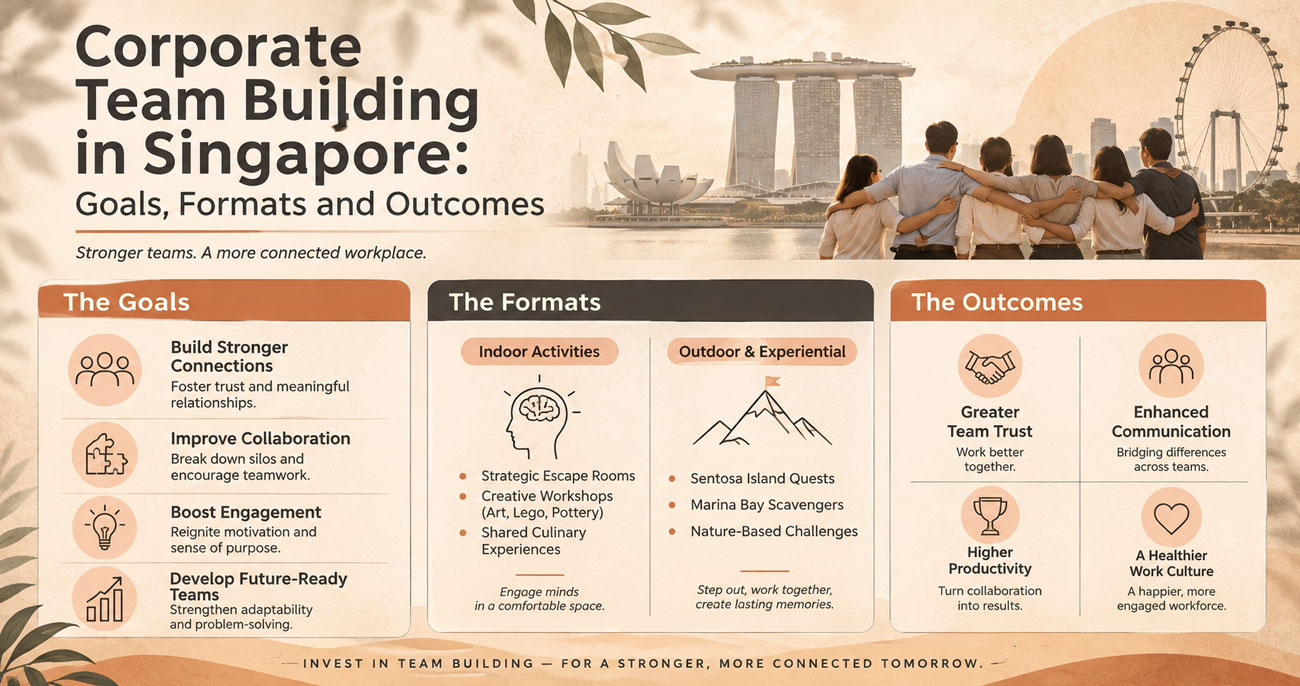
Companies frequently organize offsite events or corporate team building in Singapore, believing physical proximity automatically generates teamwork, rebuild psychological safety or relational trust among exhausted workforces. Real connection requires removing the stakes of failure. Employees need an environment free from the immediate pressures of key performance indicators. The local workforce operates under a relentless script of constant upgrading. They face real costs of living, inflation, and a deeply ingrained pressure to perform at all costs. An effective team building event interrupts this cycle.
Why Invest in Organizational Collaborative Chemistry?
Most modern business structures isolate people by design. Employees sit feet away from each other but communicate entirely through screens. They manage projects across varying comfort levels without ever learning how their peers process stress or handle unexpected failure. Genuine workplace chemistry develops only when individuals feel secure enough to expose their cognitive blind spots.
Strategic Structural Alignment
Workplace culture fractures when personal identities clash with rigid institutional demands. A strategic event forces participants to navigate tasks that mimic office pressures but lack the career-ending consequences. Teams learn to recognize exactly how their colleagues respond under fire. Implementing a dedicated framework to improve team dynamics involves mapping these hidden emotional responses. Organizations that understand the unwritten rules governing employee behavior can align individual talents directly with broader company objectives.
Multicultural Team Chemistry
Singapore remains a highly dense hub for international business. Expatriates and local residents frequently share the same office space while holding entirely different communication styles and cultural expectations. Shared interactive goals bridge these unspoken divides. When individuals rely on diverse perspectives to solve immediate physical or mental puzzles, they bypass traditional corporate hierarchy. Engaging in outdoor and cultural problem-solving team itineraries forces mixed groups to decode unfamiliar local contexts together. This shared vulnerability builds a foundation of trust that translates directly back to the boardroom.
Operational Silo Reduction
Departments instinctively hoard information. The marketing department rarely understands the technical constraints of the engineering team. This isolation breeds resentment and slows down project development. Group activities disrupt these established borders by forcing cross-functional collaboration. When experiential, culinary, and large-scale activations scramble departmental lines, people finally talk to the colleagues they usually only email. They realize the invisible obstacles slowing down company progress are often just simple misunderstandings. Poor Team Dynamics vanish when colleagues view each other as actual human beings rather than corporate roadblocks.
Indoor Activity and Workshop Formats
Singapore weather heavily dictates corporate planning. Moving away from the brutal midday heat allows for highly focused, mentally engaging sessions. The best team building activities often happen in air-conditioned spaces where comfort levels remain high.
Strategic Escape Rooms
A 15-foot locked room or gamification can reveal exactly who dominates the conversation and who shuts down under a ticking clock. Escape room challenges place 10 to 15 people in a highly controlled analytical environment. They must sift through scattered clues, decipher codes, and communicate findings before the timer expires. The format naturally highlights emerging leaders and exposes communication bottlenecks. It is a dense, high-pressure puzzle that requires absolute coordination.
Creative Workshop Sessions
Art and creative play lower defensive barriers instantly. Engaging in structured, collaborative brick play forces active listening. When adults build something tangible with their hands, they stop worrying about sounding intelligent. They simply create. The hierarchy flattens. Setting goals during these sessions feels less like a corporate mandate and more like a shared artistic vision. Pottery making, painting, or terrarium building allows quiet talents to shine in ways standard office meetings never permit.
Shared Culinary Experiences
Sometimes the most effective team bonding experience involves simply sitting down and eating food. A simple two to three-hour meal planned during work hours gives employees the spaciousness to breathe. No forced icebreakers. No manufactured corporate values discussion. Just a shared meal. This format respects the emotional weight people carry and offers a rare moment of unstructured connection.
Outdoor and Experiential Group Challenges
Outdoor environments introduce unpredictability. The natural elements force teams to adapt quickly to changing conditions.
Sentosa Island Quests
Taking a group to an artificial beach requires a specific kind of logistical endurance. Operating in marine and island environments often involves floating team-building challenges or water sports. The heat routinely hits 90 degrees Fahrenheit. People will sweat. People will complain. That shared discomfort frequently becomes the most memorable part of the day. Surviving the humidity together builds a strange but durable camaraderie.
Marina Bay Scavengers
Treasure hunts spread across the downtown core turn the city into a sprawling game board. Participants walk two to three miles navigating landmarks, solving riddles, and completing physical tasks. These hunts require actual navigational communication and frequent water breaks. Teams must monitor each other for fatigue while strategizing the most efficient route.
Corporate Social Responsibility
Volunteering can provide a deeply grounding alternative to standard arena games. Teams might prepare meals for the underprivileged like Willing Hearts, clean up local coastlines, or assemble furniture for low-income households. The shared labor anchors the group in reality. It shifts the focus away from internal corporate metrics toward tangible community impact.
Plan Effective Events Step-by-Step
Logistics dictate the ultimate success or failure of any corporate gathering. Poor planning breeds instant resentment among the staff.
Group Skill Evaluations
You must evaluate the physical capabilities of your team members before booking anything. Not everyone wants to run around a laser tag arena carrying a 5-pound vest. Pushing employees beyond their physical comfort zone in front of their managers destroys psychological safety. Assess the demographic. A team of older executives will require a vastly different activity than a group of young software developers.
Local Venue Budgets
Allocating sufficient funds for the venue prevents a host of operational disasters. Cheap booking options often result in cramped spaces, broken equipment, and terrible acoustics. A well-funded venue in Kallang or a premium downtown office space provides the necessary infrastructure for complex workshops. You get what you pay for. Quality facilitators and premium locations demand a realistic budget.
Hybrid Ideation Mechanics
Do not make brainstorming the entire event. Putting people in a room and demanding spontaneous creativity usually results in a few loud voices dominating the room while introverts withdraw completely. A hybrid approach respects different cognitive processing speeds.
- Distribute the core problem or theme to participants several days before the actual event to allow independent reflection.
- Mandate a strict ten-minute silent writing period at the start of the session where individuals outline their thoughts without interruption.
- Pair people into micro-groups of two or three to test initial ideas before presenting them to the wider room.
- Appoint a neutral timekeeper who actively interrupts cyclical arguments and ensures every person speaks at least once.
What Are Mandatory Participation Risks?
If a team building event is compulsory, you must treat it like actual work time. Forcing employees to surrender their personal weekends for mandatory corporate fun violates boundaries and breeds quiet hostility. The official tripartite policy context in Singapore carefully monitors workforce development and employee welfare. Blurring the lines between compensated labor and forced extracurricular activities invites legal scrutiny. Ignoring the established public feedback mechanisms regarding employment guidelines damages trust. You cannot demand loyalty while simultaneously stealing time.
Avoid Expensive Forced Fun Initiatives
Most corporate team building in Singapore is just expensive forced fun dressed up as strategic alignment. Skip the generic games and the overly enthusiastic paid facilitators. For a group of 10 to 15 people, a relaxed activity that people can actually opt into works best. Nobody needs to be dragged to Sentosa against their will just to prove they can collaborate on a spreadsheet. Give people autonomy. If they want to connect, provide the space. If they are exhausted, let them rest. Compliance is not character, and forced participation does not equal genuine engagement.
How Do You Measure Performance Outcomes?
You cannot measure trust on a spreadsheet. You can track shifts in behavioral patterns. You watch how a team handles a crisis three weeks after the event.
| Measurement Category | Observation Metric | Expected Healthy Outcome |
|---|---|---|
| Communication Flow | Frequency of cross-departmental questions | Employees ask for help earlier in the project cycle. |
| Conflict Resolution | Tone and duration of internal disagreements | Arguments focus on the task rather than personal flaws. |
| Psychological Safety | Number of new ideas proposed in meetings | Junior staff volunteer unpolished concepts without fear of mockery. |
Tracking these subtle shifts provides a realistic view of the team performance. Actionable goal attainment happens when the relational friction disappears.
FAQ
Do we really need an external facilitator? An external facilitator acts as a neutral party. They absorb the initial awkwardness and prevent senior management from accidentally taking over the entire session.
How long should a team building session last? Three to four hours hits the sweet spot. Full-day events often devolve into exhausted clock-watching by 3 PM unless it is well executed and supported by additional facilitators.
Should we mix different departments together? It depends. Keeping established teams together reinforces existing silos. Mixing departments can push individuals to interact with colleagues they usually ignore.
What happens if someone refuses to participate? Let them sit out. Forcing a highly anxious or resistant employee to play a game against their will guarantees a miserable experience for everyone involved.
Conclusion
We live in a culture obsessed with optimizing output. We scale everything. We track every metric. We forget basic human requirements for connection and emotional safety. Corporate team building in Singapore carries the heavy burden of undoing the daily relational damage caused by high-pressure environments. When executed with empathy and clear boundaries, these events provide a rare pocket of spaciousness. They remind a frantic workforce that smaller people do not always get hurt by bigger people. True authority within a company is earned through trust and time spent together in the messy, unstructured moments of shared experience.

Michelle Mah is a psychotherapist, mindfulness practitioner, and wellbeing advocate who has transformed lives through her work with individuals and organizations.
Drawing from her personal journey overcoming mental health challenges including an eating disorder at the peak of her corporate career, she has been featured on TEDx, CNA, TODAY, and MoneyFM and aims to inspire others to achieve personal transformation and sustainable growth.
With expertise in delivering evidence-based wellbeing programs, Michelle integrates a variety of tools and modalities within psychotherapy, organisational development, mindfulness, and Neuro-Linguistic Programming (NLP) to help clients enhance resilience, self-awareness, and emotional wellbeing. Her credentials include an Advanced Psychotherapy Certification in Perinatal Mental Health and a 300-hour Yoga Alliance certification, having curated corporate wellbeing retreats across Asia.
She is also an adjunct lecturer at Nanyang Technological University and delivers programmes for Singapore Management University, bringing a unique blend of academic insight and practical strategies to empower individuals and youths.