
Introduction
Everyone packs into a freezing hotel ballroom hoping to emerge somewhat transformed. The fundamental purpose of a corporate seminar in Singapore is not merely knowledge transfer. It is a strategic tool designed to forge psychological safety, align collective business objectives, and create a shared cognitive space for professionals away from their usual desks. We optimize for productivity so aggressively in this country. It is almost radical to put people in a room and ask them to just learn together as human beings.
Bringing teams together under one roof offers a profound professional benefit. It forces a pause. When organizations intentionally step away from the daily grind of clearing emails, they open up a rare window for evidence-based problem solving and actual relational repair. We live in a culture obsessed with scale and constant upgrading. Yet the most successful business conferences in Singapore 2026 are not the ones packing three thousand people into an expo hall to stare at a screen. They are the ones facilitating intimate, highly targeted audience interactions where professionals can turn interest into real business outcomes. Let us look at how organizations actually make these events matter.
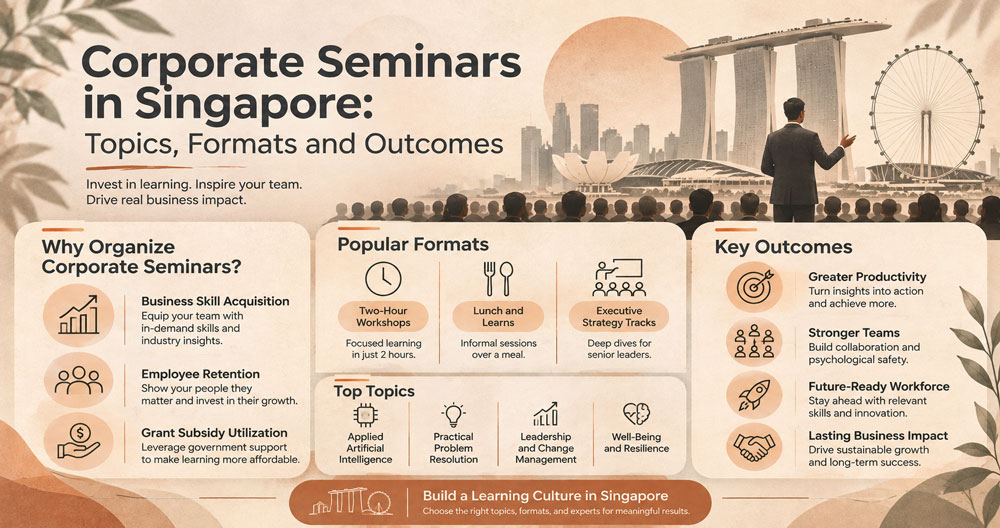
Why Do Singapore Enterprises Organize Professional Events?
Companies do not just burn capital for fun. They deploy resources intentionally. The underlying motivation to host an event usually stems from a need to shift behavior, introduce new technologies, or simply remind a fragmented workforce that they are part of a larger community.
Business Skill Acquisition
Things change fast. A marketing team operating on five-year-old assumptions is already obsolete. Enterprises send their people to targeted masterclasses to acquire tangible, technical competence across specific capability areas. But memorizing a new framework is not the same as understanding it. Getting a certificate does not automatically build a curious workforce. True skill acquisition requires a container where employees feel safe enough to admit what they do not know.
To systematically address this, organizations usually prioritize three developmental pillars:
- Identifying critical knowledge gaps within the current team structure.
- Partnering with an industry-specific service provider who understands local market nuances.
- Ensuring the curriculum focuses on evidence-based methodologies rather than outdated corporate folklore.
Employee Retention Rates
The metrics betray a simple truth. People leave when they feel invisible. A well-structured corporate event shows investment. It tells the team they are worth the financial outlay and the time away from their desks. This builds resilience. When leaders prioritize their team’s growth, they naturally foster empowerment. Employees who feel nurtured are far less likely to jump ship for a marginal salary bump.
Grant Subsidy Utilization
Money carries emotional weight. In Singapore, money also carries massive state support. Organizations lean heavily on key government agencies and chambers to offset the costs of continuous education. Accessing enterprise-level funding transforms a prohibitive expense into a feasible investment. Companies actively tap into available financial support to upgrade their operations, knowing that ignoring these subsidies leaves money on the table.
Which Delivery Formats Drive Maximum Engagement?
Industry experts continually note a heavy pivot toward micro-learning. Three days in a windowless room is out. Multi-day conferences are losing traction due to modern corporate time constraints and the realities of hybrid work environments. Analysts from the Anagram Group have pointed out that organizations increasingly favor short, high-impact sessions.
Two-Hour Workshops
People are tired. Two hours is exactly enough time to introduce a holistic concept and gain practical insights without draining a person’s social battery. You get in, you explore a targeted issue like cyber security excellence, and you get out before the afternoon slump hits. This format forces speakers to distill their presentations into pure, actionable value.
Lunch and Learns
Bite-sized corporate training fits perfectly into the modern schedule. It removes the pressure. You eat, you listen, you discuss. Sharing a meal fundamentally changes the dynamic in the room. It flattens the hierarchy. Junior staff are more likely to ask questions when everyone is holding a sandwich. It is a brilliant way to integrate learning into the natural rhythm of the day.
Executive Strategy Tracks
Sometimes you need deep work. Senior leaders often gather for targeted leadership alignment strategies to untangle complex organizational knots. These sessions strip away the superficial buzzwords. They require radical vulnerability from founders and executives who are used to having all the answers. Stepping into a room to admit you need clarity takes courage.
What Topics Deliver Measurable Business Outcomes?
Third-party reviews from participants constantly warn about generic sessions. A complete waste of time. Corporate professionals highly value interactive, industry-tailored workshops that focus on problem-solving over dry academic concepts.
Applied Artificial Intelligence
AI adds another complicated layer to our daily lives. Employees using it often report feeling lonelier. We need seminars that teach the human application of digital tools, rather than just treating them as a magic button for output. Exploring the intersection of human intelligence and machine capability is critical. We are optimizing for output and quietly eroding the conditions that make people feel seen.
Practical Problem Resolution
Real business outcomes stem from teaching teams how to navigate ambiguity. Structured thinking changes behavior. You can look at Core Frameworks and Expected Outcomes to understand how intentional design impacts professional growth. Teaching a team to handle a crisis without turning on each other is perhaps the most valuable training any company can provide.
Advanced Workplace Communication
True relational repair requires teaching the difference between power and authority. We need compassionate communication. Compliance is not character. Getting an employee to follow rules out of fear does not mean they respect the leadership. Seminars focusing on emotional intelligence, conflict de-escalation, and trauma-informed leadership yield immediate dividends in workplace harmony.
Select the Ideal City Venue
Environment dictates behavior. Putting people in a cramped, poorly lit room guarantees a terrible outcome, regardless of how good the agenda is. Venue selection is a critical logistical pillar that requires balancing budget, accessibility, and the specific vibe you want to cultivate.
| Venue Category | Ideal Audience Size | Primary Advantage | Typical Use Case |
|---|---|---|---|
| Premium Hotel | 50 to 500 attendees | High-end catering and built-in hospitality services | Annual company summits, major networking events |
| Convention Center | 500+ attendees | Massive floor space and robust technical infrastructure | Large-scale exhibitions, multi-track symposiums |
| Boutique Workspace | 10 to 50 attendees | Intimate atmosphere promoting psychological safety | Leadership offsites, specialized masterclasses |
Premium Hotel Ballrooms
These spaces are built for massive scale. They are often utilized for large regional trade conventions and high-profile industry gatherings. They offer excellent catering and technical support. Oddly enough, they can also feel incredibly sterile. You have to work harder to inject warmth into a room dominated by chandeliers and patterned carpets.
Dedicated Convention Centers
The heavy lifters of the MICE industry. Perfect when you have hundreds of attendees, exhibitors, and complex staging needs. Places like Marina Bay Sands or Suntec City are engineered to move thousands of people efficiently. They are the default choice for the largest business events for SMEs and global summits.
Boutique Shared Workspaces
I personally prefer these. Smaller rooms encourage eye contact. A bespoke vita venue or a beautifully designed boardroom feels less like a corporate obligation and more like a human gathering. These spaces naturally foster the intimate, face conversations that actually lead to meaningful connections.
Execute the Event Logistics Process
Professional coordinators will tell you that technical execution dictates everything. You can have the most brilliant keynote speakers on earth, but if the registration line takes an hour, your attendees are already annoyed. Active experience management is non-negotiable.
Attendee Registration Workflows
Keep it invisible. Digital check-ins and automated badge printing remove the initial friction. The first five minutes of an attendee’s experience sets the tone for the entire day. If they feel taken care of immediately, their nervous systems settle. They become receptive to learning.
Session Transition Timelines
Allow spaciousness. Back-to-back sessions ruin the nervous system. People need time to digest information. They need to grab coffee. They need space to engage in speed networking without anxiously checking their watches. Rushing from one room to another completely destroys any chance of mindful reflection.
Friction Point Mitigation
Anticipate the problems before they happen. Bad Wi-Fi, freezing air conditioning, confusing wayfinding. These small irritations compound quickly. Walk the space yourself. If a specific room feels claustrophobic, change it. If the catering line forces people to stand in a narrow hallway, move the tables.
How to Measure Post-Event Success?
Did we actually achieve anything? You have to ask. Post-event evaluations need to be mandatory, but they also need to be compassionate. Do not just ask if the food was good. Ask if the participants felt heard. Ask if they walked away with a clearer understanding of their role.
Evaluate the long-term impact by monitoring team dynamics weeks after the event concludes. Look at current domestic financial conditions and see if the new skills your team acquired are actually helping the company navigate the prevailing economic climate. A successful seminar changes the daily vernacular of the office. People start using the shared frameworks spontaneously.
How Do State Subsidies Impact Budgets?
Understanding how to Navigate Treatment Costs Across Singapore is vital when thinking about personal coaching. The exact same logic applies to corporate training budgets. The availability of government grants drastically alters what a company can afford.
Subsidies allow organizations to hire highly specialized, evidence-based trainers instead of cutting corners with generic providers. We frequently see companies mandating accredited professional development courses to ensure regulatory compliance while simultaneously keeping their out-of-pocket expenses remarkably low. It is a highly strategic way to fund continuous development without jeopardizing cash flow. You just have to be willing to navigate the paperwork.
FAQ
What makes a corporate seminar genuinely effective? An effective session prioritizes psychological safety and practical application over passive listening. It gives professionals the exact tools they need to solve their daily problems.
Are full-day conferences still relevant? They have their place for massive networking events or annual kick-offs. However, for actual skill acquisition, shorter, targeted workshops are far more respectful of a person’s cognitive limits.
How do you choose the right service provider? Look for facilitators who ask questions about your company culture before they try to sell you a curriculum. You want someone who understands the specific pressures of your industry, not someone reading from a standardized script.
Can small businesses afford premium training in Singapore? Yes. Between various chamber subsidies and national agency grants, small and medium enterprises have unprecedented access to financial support designed specifically for capability upgrading.
Conclusion
We spend a massive portion of our waking lives at work. The spaces we create for professional development should reflect the deep respect we have for that time. Corporate seminars in Singapore do not have to be an exercise in endurance. They can be meticulously crafted environments where curiosity is rewarded, where leaders learn to listen, and where genuine human connection drives organizational growth. Stop optimizing purely for output. Start optimizing for the people producing it.

Michelle Mah is a psychotherapist, mindfulness practitioner, and wellbeing advocate who has transformed lives through her work with individuals and organizations.
Drawing from her personal journey overcoming mental health challenges including an eating disorder at the peak of her corporate career, she has been featured on TEDx, CNA, TODAY, and MoneyFM and aims to inspire others to achieve personal transformation and sustainable growth.
With expertise in delivering evidence-based wellbeing programs, Michelle integrates a variety of tools and modalities within psychotherapy, organisational development, mindfulness, and Neuro-Linguistic Programming (NLP) to help clients enhance resilience, self-awareness, and emotional wellbeing. Her credentials include an Advanced Psychotherapy Certification in Perinatal Mental Health and a 300-hour Yoga Alliance certification, having curated corporate wellbeing retreats across Asia.
She is also an adjunct lecturer at Nanyang Technological University and delivers programmes for Singapore Management University, bringing a unique blend of academic insight and practical strategies to empower individuals and youths.